
Mistakes in gold trading are not limited to predicting the wrong price direction. A trader can identify the broad market trend and still lose money through excessive exposure, costs, weak execution or an inconsistent decision process. The following ten errors are useful to recognise, but avoiding them does not guarantee profitable trading.
1. Trading before knowing the contract
A displayed XAU/USD quote does not explain how many ounces a CFD lot represents, when financing is charged or who acts as the counterparty. Control: read instrument specifications and test the dollar gain or loss for a $10-per-ounce change.
2. Choosing lot size from available margin
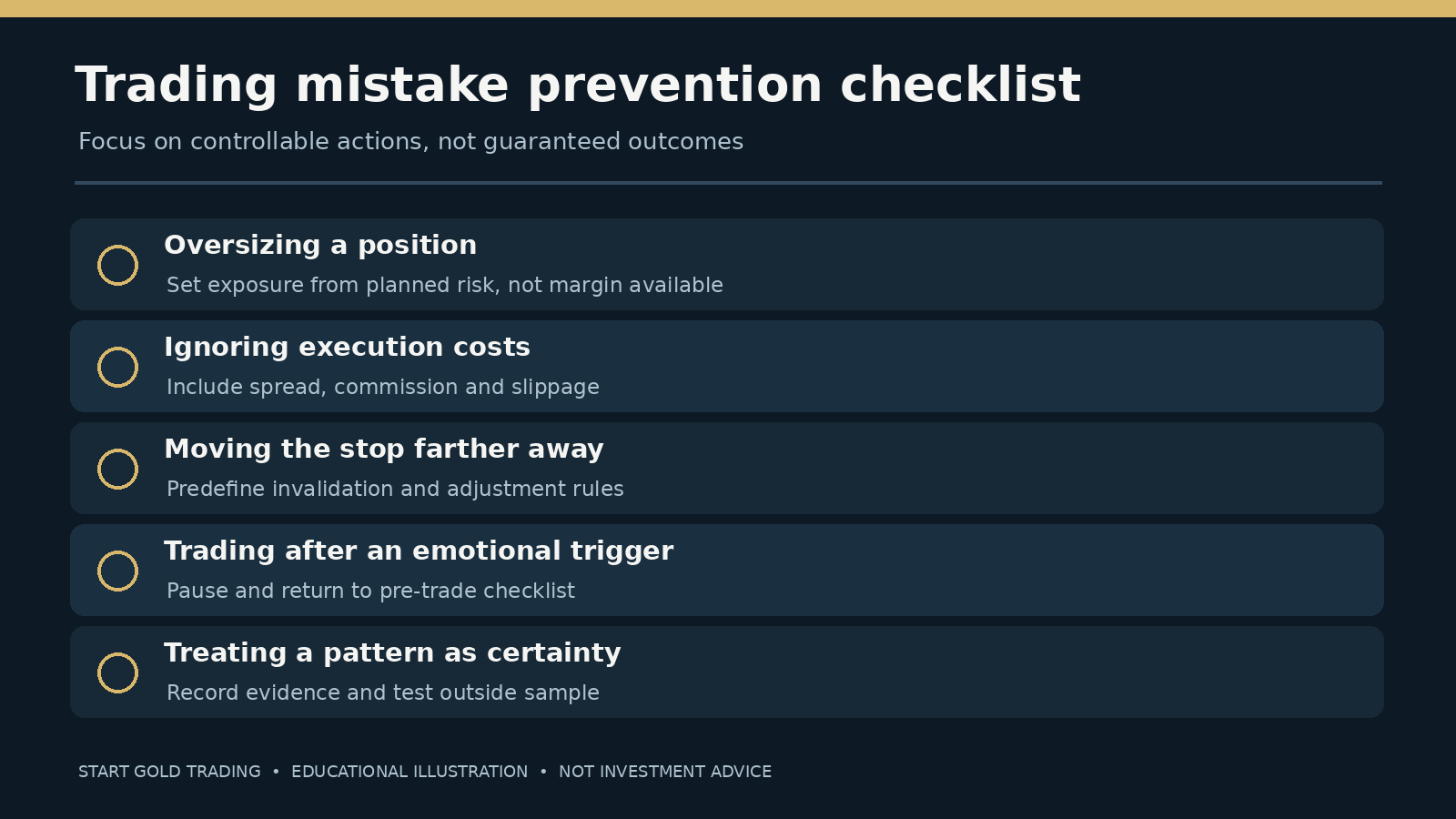
The ability to open a position does not make that exposure affordable. Leverage amplifies the account impact of price changes. Control: decide a planned loss budget and invalidation level first, then calculate ounces of exposure.
3. Treating stop-loss orders as guarantees
Stops may trigger at a price but fill beyond it during gaps or volatile conditions. Control: include plausible slippage and spread changes in risk scenarios; read the provider’s execution policy.
4. Changing a stop simply to avoid taking a loss
Moving a stop farther from entry increases planned risk unless exposure is reduced. Control: define adjustments in advance and record every deviation from the original plan.
5. Ignoring full trading costs
Spreads, commissions, funding, conversion and slippage can erase an otherwise small price advantage. Control: track net rather than gross results and include realistic execution costs in any strategy test. Investor.gov describes how costs reduce investment returns.
6. Trading simply because gold made a large move
Fear of missing out can lead to buying after a price surge or selling after a panic, without a defined setup. Control: require a written reason, an invalidation level and an acceptable execution price; sometimes the correct decision is not to trade.
7. Revenge trading after losses
Increasing size to recover a previous loss changes the risk profile and can create a self-reinforcing sequence. Control: use a predetermined pause rule or daily loss limit and review the last trade before considering another.
8. Overinterpreting chart indicators
RSI, moving averages and patterns summarise observed prices; they do not expose all OTC market order flow or reliably forecast the next move. Control: treat indicator rules as hypotheses, validate them out of sample and assess their failure conditions.
9. Stacking correlated positions
Several trades in gold and correlated markets may create one large directional exposure even if each ticket looks small. Control: total the notional and planned risk across open positions instead of reviewing each trade alone.
10. Reviewing only winning trades
Selective memory creates overconfidence. Control: document all trades and non-trading decisions, including entry reasons, fill quality, costs, stops, missed signals and mistakes.
A short pre-trade safeguard
| Check | Question to answer |
|---|---|
| Instrument | What exactly is one unit or lot? |
| Risk | What is my intended loss and what if the fill is worse? |
| Reason | Is there a defined setup or am I reacting to emotion? |
| Costs | What is my estimated net result after charges? |
| Review | What will I record for future evaluation? |
What if you keep repeating the same mistake?
A recurring error may show that the rule is too vague, the product is unsuitable for the account size, or the trading environment is incompatible with your decision process. An extended break and review can be more useful than an extra indicator. See MoneySense’s CFD risk explanation and Investor.gov’s planning guidance for broader context.
Key takeaway
Reducing avoidable mistakes is about controlling exposure and behaviour, not promising a positive return. Separate decision quality from the outcome of any one trade.
Sources
- MoneySense — Understanding CFDs
- Investor.gov — How Fees Affect Returns
- Investor.gov — Invest for Your Goals
Continue learning
- Gold Trading for Beginners — Five-Stage Learning Guide
- Candlestick Patterns Explained
- Gold Trading Risk Management
Educational information only. Gold prices and leveraged derivatives can produce substantial losses. Examples are hypothetical and are not personal financial advice.