

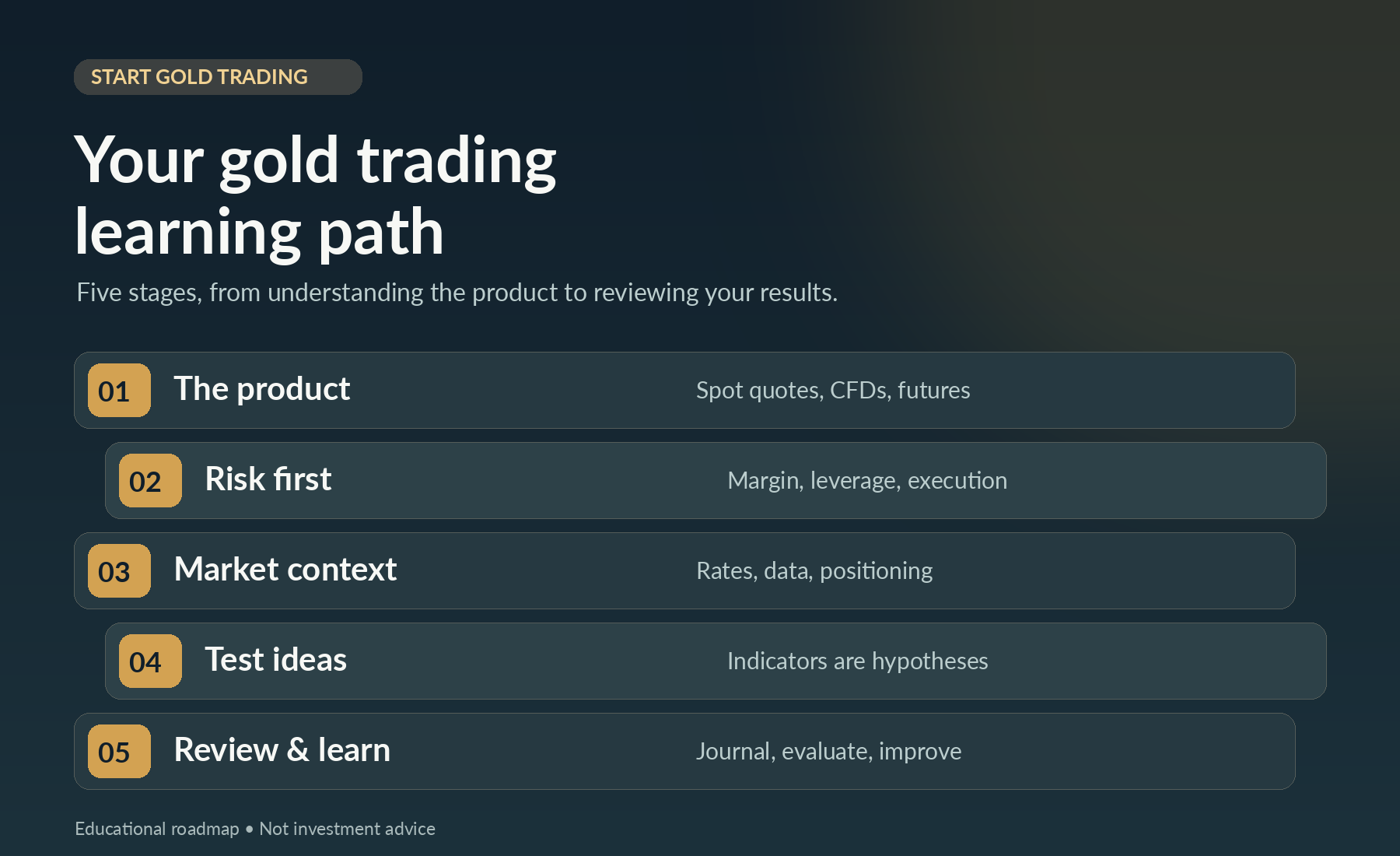
Gold trading is easier to study when you separate the product, its risks, the market information and your own decision-making process. This learning hub organises our 30 chapters into five stages, so you can work through the foundations before considering more demanding trading approaches.
Use this as an educational reading plan, not a promise of trading success. You can understand a market and still lose money. The chapter links below are retained from the original guide; their individual contents should be assessed separately.
Before you begin: know what you are trading
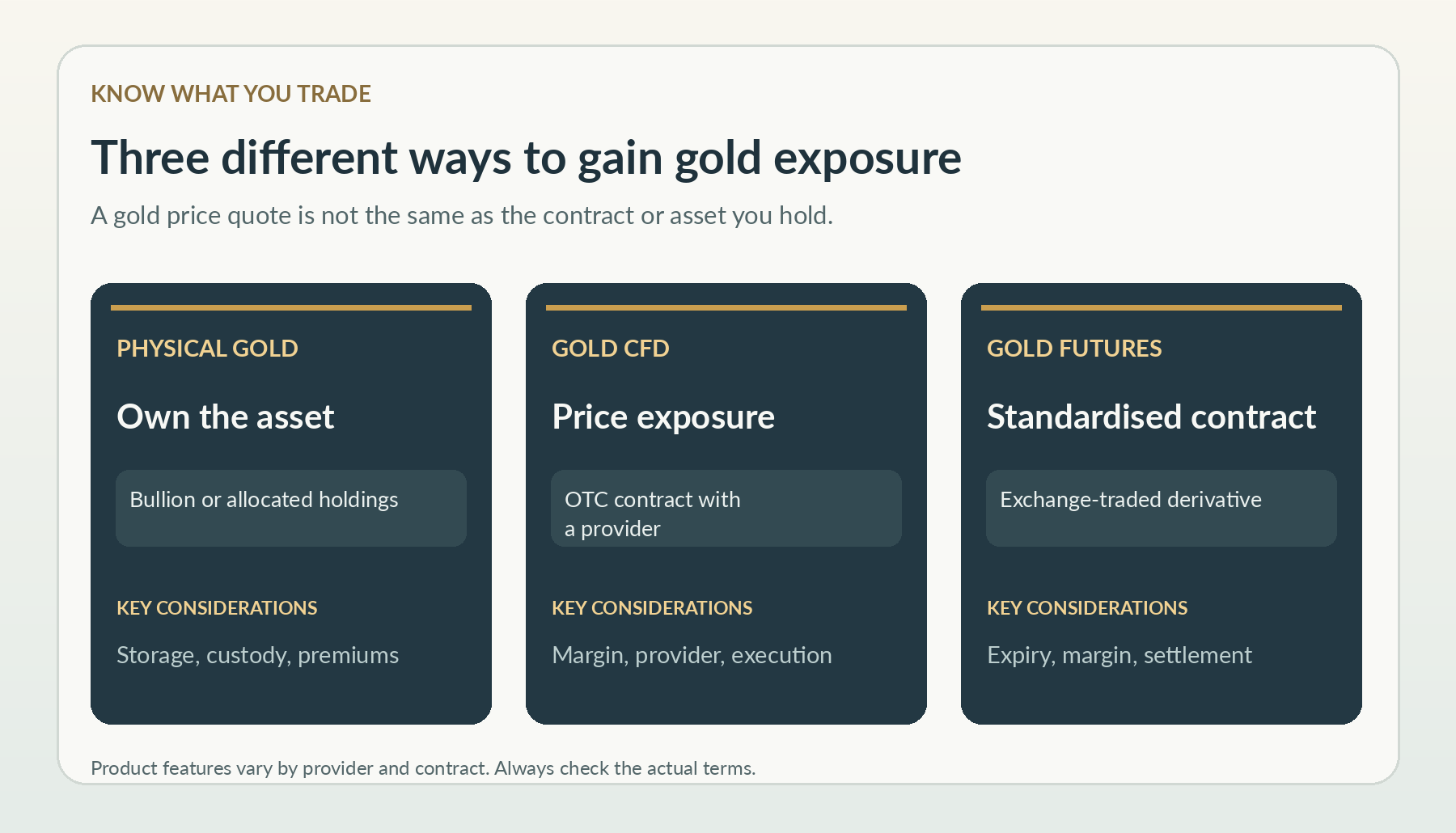
A gold CFD gives exposure to price changes without ownership of physical gold. CFDs are typically over-the-counter contracts with a provider. Read the provider’s contract specifications, costs, execution policy and margin rules; a quoted gold price alone does not describe the product. MoneySense explains CFD mechanics and risks.
Exchange-traded gold futures are a different contract. For example, CME’s standard GC contract represents 100 troy ounces. Do not assume a CFD broker’s lot size is identical. Check the actual instrument specifications. See CME’s gold futures information.
Risk comes before strategy
Leverage magnifies exposure relative to the margin you deposit. Margin is not a guaranteed maximum loss. A stop-loss order may execute at a worse price than requested, particularly around gaps or fast markets. Costs and funding charges also affect results. Check the protections applicable to your specific account rather than assuming they are universal.
Learning checkpoint: explain the instrument’s contract size, trading costs, margin requirements and execution risks in your own words before moving on.
Stage 1 — Understand the product and the provider
Start with the market and the contract you would actually trade. Compare the benefits claimed for gold with the risks and costs of the particular instrument.
- Introduction to Gold Trading: Exploring the Fundamentals
- Understanding CFDs: A Beginner’s Guide to Contracts for Difference
- The Advantages of Gold Trading: Why Invest in Gold?
- How to Choose a CFD Broker: Setting Up Your Gold Trading Account
Learning checkpoint: Can you distinguish owning gold from trading a derivative and explain how your provider is paid?
Stage 2 — Build a risk and decision framework
Read risk management before entry techniques. Turn general intentions into a written process covering exposure, exits, loss limits and the behaviour you want to avoid.
- Risk Management in Gold Trading: Protecting Your Investments
- Leveraging Your Gold Trades: Understanding and Applying Leverage
- How to Use Stop Losses and Take Profits in Gold Trading
- Common Gold Trading Mistakes and How to Avoid Them
- Crafting a Gold Trading Plan: Essential Elements for Success
- The Psychology of Trading Gold: Maintaining Discipline and Patience
Learning checkpoint: Can you describe what happens if the market gaps past your stop or your margin falls below the required level?
Stage 3 — Read the economic and market context
Organise the information you follow. Separate published data from forecasts and describe alternative outcomes rather than committing to one inevitable price path.
- Fundamental Analysis in Gold Trading: What Drives Gold Prices?
- Economic Events and Gold Price Volatility: How to Trade Smart
- How to Trade Gold During Major News Releases
- Correlation Between Gold and Forex Markets: Trading Insights
- The Best Times to Trade Gold: Understanding Market Hours
- Seasonal Trends in Gold Trading: How to Capitalize on Market Cycles
Learning checkpoint: For each market view, can you identify the evidence, its timestamp and what would change your conclusion?
Stage 4 — Study approaches as hypotheses to test
Compare chart tools, holding periods and execution demands. Treat an appealing pattern or indicator as a hypothesis that needs testing, not proof of a profitable edge. The original chapter titles are retained for navigation and should not be read as verified performance claims.
- Technical Analysis for Beginners: Mastering Gold Trading Charts
- Candlestick Patterns Explained: Decoding Gold Price Charts
- Trading Indicators and Gold: Using MACD, RSI, and Others
- Effective Entry and Exit Strategies in Gold Trading
- Scalping and Day Trading Gold: Techniques for Quick Profits
- Swing Trading Gold: Strategies for Medium-Term Investors
- Long-Term Gold Trading Strategies: Building a Durable Portfolio
- Diversifying Your Portfolio with Gold Trading
- Advanced Charting Techniques for Gold Traders
- Automated Trading Systems for Gold: Exploring the Benefits and Risks
Learning checkpoint: Can you define a repeatable rule and evaluate it after costs, including losing periods and data outside the period used to develop it?
Stage 5 — Review results and keep learning
Use a journal to compare what you planned with what you did. Record costs, mistakes and uncertainty as well as results. Review your process before adding more complexity.
- Evaluating and Adjusting Your Gold Trading Strategy
- How to Learn from Your Trading Journal
- Essential Resources and Tools for Gold Traders
- Advancing Your Gold Trading Skills: Next Steps for Growth
Learning checkpoint: Can you explain whether an improvement is supported by enough observations, rather than by a few recent wins?
How to use this hub
Work through one stage at a time. Keep notes on unfamiliar terms, follow the original chapter links and return to the risk section whenever a strategy increases exposure. There is no requirement to trade live to complete this learning plan.
Supplementary guides: explore specific gold markets and tools
After completing the relevant learning stage, these focused guides offer additional examples and product-specific explanations. They are supplementary reading, not shortcuts to a profitable strategy.
- RSI momentum, divergences and common mistakes
- How to become a gold trader: markets and learning roadmap
- Gold futures contract size, margin and a rules-based example
- Gold options: calls, puts and futures options
- How to test a simple gold trading strategy
- Compare gold products and choose a trading platform
Sources and editorial scope
- MoneySense: Understanding contracts for difference — product mechanics, margin, costs and execution risk.
- CME Group: Gold Futures — exchange-traded contract information.
This hub is educational material, not personalised investment advice or a recommendation to trade. The five-stage sequence is an editorial learning framework. It does not certify the accuracy, profitability or suitability of the individual linked strategies.