

A gold trading plan is a written description of when to act, when to stay out, how much exposure to take and how to review the result. It can make decision-making more repeatable, but it does not create a profitable market edge by itself. Start by understanding the product and the money you can afford to put at risk.
Define the purpose and limitations
Distinguish learning, strategy testing and live trading. Consider your financial circumstances, time horizon and willingness to lose some or all of the capital at risk. Investor.gov’s risk-tolerance guidance emphasises that suitability depends on individual goals and circumstances.
Write down the instrument and market conditions
- Instrument: gold CFD, futures, fund or bullion; record its relevant contract specifications.
- Trading windows: which sessions you will observe, and any periods you deliberately avoid.
- Context: major scheduled news, broker spreads, volatility and whether trading conditions are orderly.
- No-trade conditions: unclear setup, excessive financing or spread, impaired concentration, platform problems or insufficient margin headroom.
Specify the setup in testable language
Avoid phrases such as ‘buy when gold looks bullish’. State the exact observations required for entry and what evidence would contradict the idea. A moving average or a candlestick pattern may be used as part of a rule, but its predictive value must be tested rather than assumed. Your plan should allow the answer no trade.
Calculate a planned position size
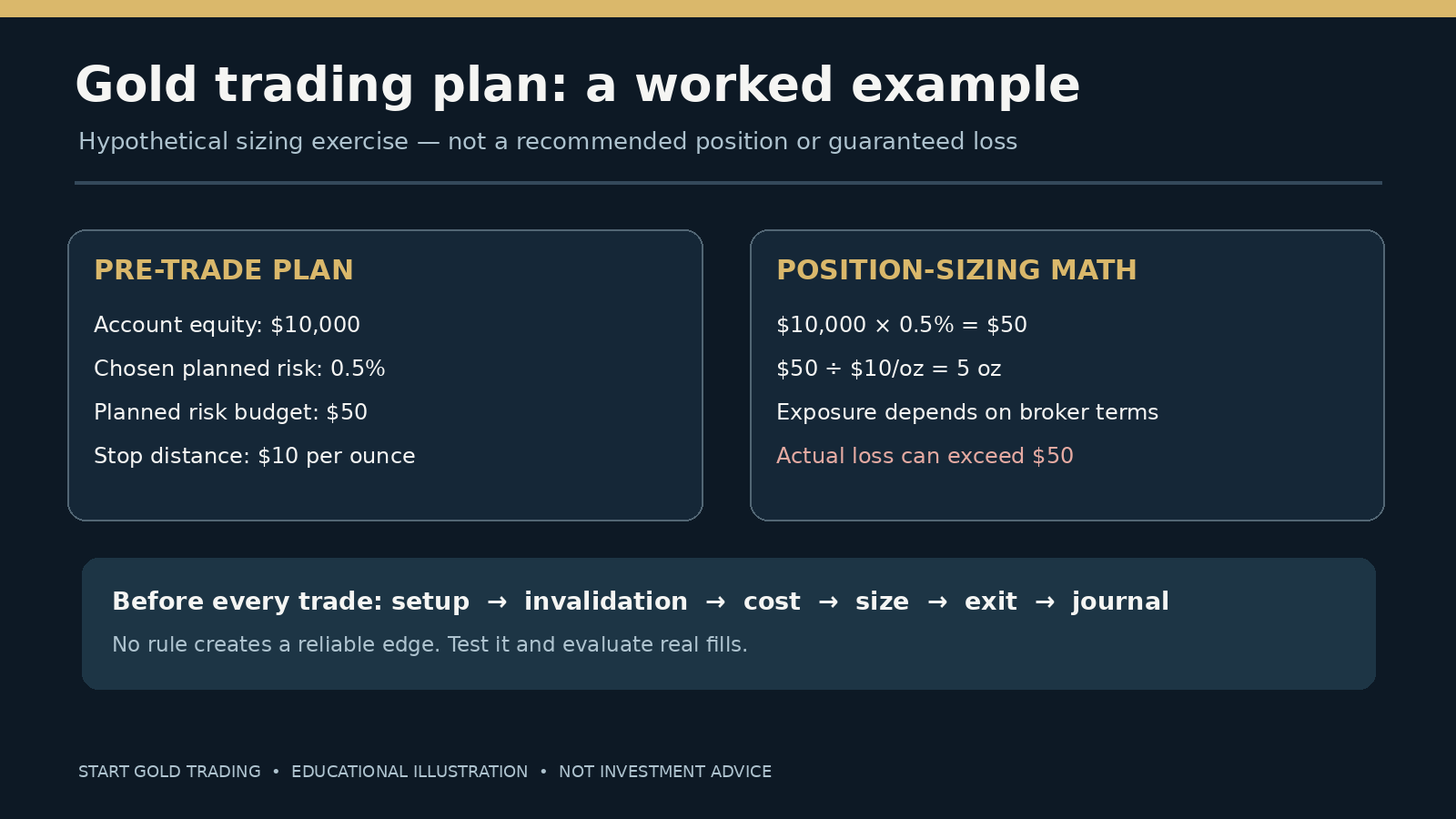
Here is a hypothetical example, not a recommendation to risk 0.5% or to trade any particular quantity.
| Step | Illustrative result |
|---|---|
| Account equity | $10,000 |
| Chosen planned budget | 0.5% × $10,000 = $50 |
| Entry-to-stop distance | $10 per ounce |
| Calculated exposure | $50 ÷ $10 per ounce = 5 ounces |
| If filled $3 beyond stop | 5 oz × $13 = $65 loss before costs |
Position size is based on ounces and the intended price distance, subject to the broker’s contract size. Actual losses can be larger than the planned $50 because of slippage, gaps, charges or provider liquidation. Initial margin is a collateral requirement, not a loss ceiling. Read MoneySense’s CFD risks before attempting leveraged products.
Document exits before entry
- Define the market condition that would invalidate the setup.
- Identify the stop order and its trigger/limit behaviour under the provider’s terms.
- Describe an optional profit-taking rule, without assuming the target will be achieved.
- State in advance whether partial exits, stop adjustments or early closes are allowed.
- Set conditions under which you must stop trading for the session or reevaluate the plan.
A one-page trading plan template
| Field | What to write |
|---|---|
| Instrument and contract | XAU/USD CFD, futures symbol, ounces per lot, broker entity |
| Evidence for entry | Observable conditions; timestamp and timeframe |
| Invalidation and risk | Price or condition; ounces; planned budget; costs |
| Execution constraints | Spread threshold, stop type, relevant news or liquidity |
| Alternative outcome | Conditions that would cancel the idea |
| Post-trade review | Planned vs actual entry/exit, net result and deviation |
Test the plan before trusting it
A backtest can be distorted by hindsight, overfitting, unrealistic spread assumptions and a short observation window. Separate data used to design the rules from data used to evaluate them. When reviewing outcomes, include losing periods, transaction costs and actual fills. No backtest eliminates uncertainty about future markets.
How often should you change the plan?
A single losing trade does not prove that the rules are wrong, and a series of wins does not prove they work. Review at a preselected interval, record what changed and why, and avoid rewriting rules immediately after an emotionally difficult session. The Investor.gov investment-planning framework provides a broader model for aligning actions with goals.
Key takeaway
A good plan defines observable choices and measurable risk, including when not to trade. It is a decision framework rather than a forecast of guaranteed returns.
Sources
- Investor.gov — Invest for Your Goals
- Investor.gov — Gauge Your Risk Tolerance
- MoneySense — Understanding CFDs
Continue learning
- Gold Trading for Beginners — Five-Stage Learning Guide
- Gold Trading Risk Management
- Gold Leverage and Margin Explained
Educational information only. Gold prices and leveraged derivatives can produce substantial losses. Examples are hypothetical and are not personal financial advice.