
Gold is traded through several very different financial products. Some buyers own bullion, others hold fund shares, and active traders may speculate through derivatives such as futures or contracts for difference (CFDs). These are not interchangeable: the risks, costs and legal rights vary as much as the price exposure.
At a glance · Estimated reading time: 4 minutes
- Start with the gold product: bullion, funds, futures and CFDs involve different rights and risks.
- Understand the market and main price drivers before calculating an individual trade.
Where this lesson fits: This is a short introduction to the gold market and its participants. For a worked XAU/USD quote, a comparison of five product structures and a hypothetical profit-and-loss calculation, continue with How Gold Trading Works: Products, Quotes and Real Risks.
What does XAU/USD mean?
XAU/USD is commonly used to describe a US-dollar quotation for one troy ounce of gold. The quote tells you a price reference, not whether you own metal, hold a regulated fund share or have a leveraged contract with a dealer. Ask what instrument is behind the screen before placing any trade.
Where does gold trading take place?
Gold has a global wholesale market with over-the-counter (OTC) transactions between counterparties as well as exchange-traded products. The London market is an important OTC centre, while exchanges also list standardised futures. These markets interact, but their quotes, settlement terms and trading hours are not identical. The World Gold Council explains OTC and exchange trading.
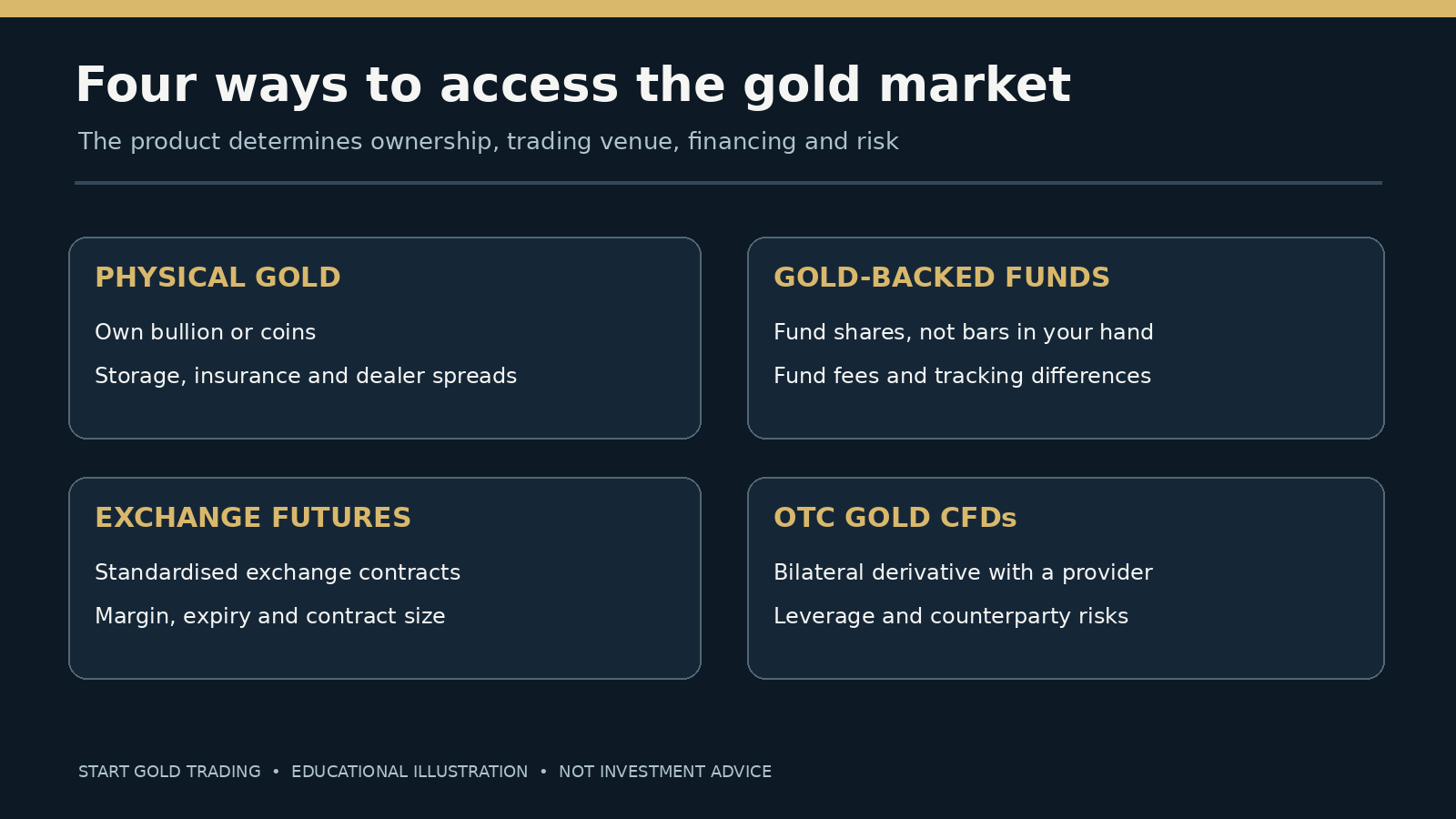
Four ways to get gold exposure
| Product | What you hold | Important considerations |
|---|---|---|
| Physical bullion | Coins or bars | Dealer premiums, storage, insurance and resale spread |
| Gold-backed investment funds | Shares or fund units | Custody structure, fees, tracking and market price |
| Exchange-traded futures | Standardised exchange contract | Margin, contract size, expiry and settlement terms |
| OTC gold CFDs | Agreement with a CFD provider | Leverage, spreads, financing, execution and counterparty risk |
A CFD typically gives you the change in the contract’s value, not the underlying gold. It can amplify gains and losses and may entail financing charges. Consult MoneySense’s CFD risk guide for Singapore-specific product explanations.
Who buys and sells gold?
Gold demand comes from jewellery, investment products, central banks and technology. Supply comes from mining and recycled gold, with hedging affecting flows. World Gold Council supply-and-demand data separates these categories. A shift in one segment may matter, but it does not determine the next price tick on its own.
Why does the gold price move?
- Interest rates and real yields: changing returns on other assets may alter the opportunity cost of holding non-interest-bearing gold.
- Currency movements: the US dollar often matters for dollar-denominated quotations, but the relationship is not mechanically inverse every day.
- Risk appetite: geopolitical or financial stress can increase demand for gold, yet forced selling may occur during liquidity shocks.
- Investment and central-bank flows: portfolio allocation and reserve decisions can affect demand over time.
- Physical supply and demand: jewellery buying, recycling and mine production are relevant, usually at a different pace from intraday trading.
Gold is not automatically a safe investment
Gold has at times served as a diversifier or safe-haven asset, but it can fall steeply and its inflation-adjusted returns vary with the period examined. A highly leveraged gold CFD can be risky even when the underlying metal is considered defensive. A good starting question is not ‘Will gold rise?’ but ‘Which product am I exposed to, and what could make the position lose money?’
A beginner’s reading checklist
- Identify whether the product represents ownership, a fund share, an exchange contract or an OTC derivative.
- Find the legal entity, contract size, currency and applicable regulatory framework.
- List all costs: premiums, spreads, custody or fund fees, commissions and financing, as applicable.
- Understand position exposure, possible slippage and any margin requirements.
- Practice explaining an adverse market scenario without assuming a guaranteed price direction.
Key takeaway
Start with the mechanics of the gold market and the particular instrument. Understanding market structure and risk does not by itself establish a profitable trading strategy.
Sources
- World Gold Council — Gold Trading in the Wholesale Market
- World Gold Council — Gold Demand and Supply
- MoneySense — Understanding CFDs
Continue learning
- Gold Trading for Beginners — Five-Stage Learning Guide
- Gold CFDs Explained: How XAU/USD Trading Works
Educational information only. Gold prices and leveraged derivatives can produce substantial losses. Examples are hypothetical and are not personal financial advice.