

Swing trading gold refers to holding an exposure through a price movement over several days or weeks. It differs from day trading because a position may remain open during economic releases, overnight sessions and weekend closures. Holding longer reduces the frequency of entry decisions but adds gap, financing and market-regime risks.
Define the product before the holding period
A position in physical bullion, a gold-linked fund, a listed futures contract and an OTC gold CFD can all move with gold, yet their rights and costs are fundamentally different. CFDs usually do not convey gold ownership and may require financing and margin top-ups. Listed futures have specified contract sizes and expiration rules; check CME’s gold futures specifications and the provider’s terms.
What swing-trading signals really show
Moving averages summarise past closing prices; a crossover indicates that the averages changed order in a completed observation. RSI describes recent relative up and down moves; a low reading is not proof that a reversal is imminent. Traders who wish to test signals should define both the setup and the period to be evaluated, then measure outcomes after costs rather than assuming a successful trend.
Overnight risk is not identical to a daily stop
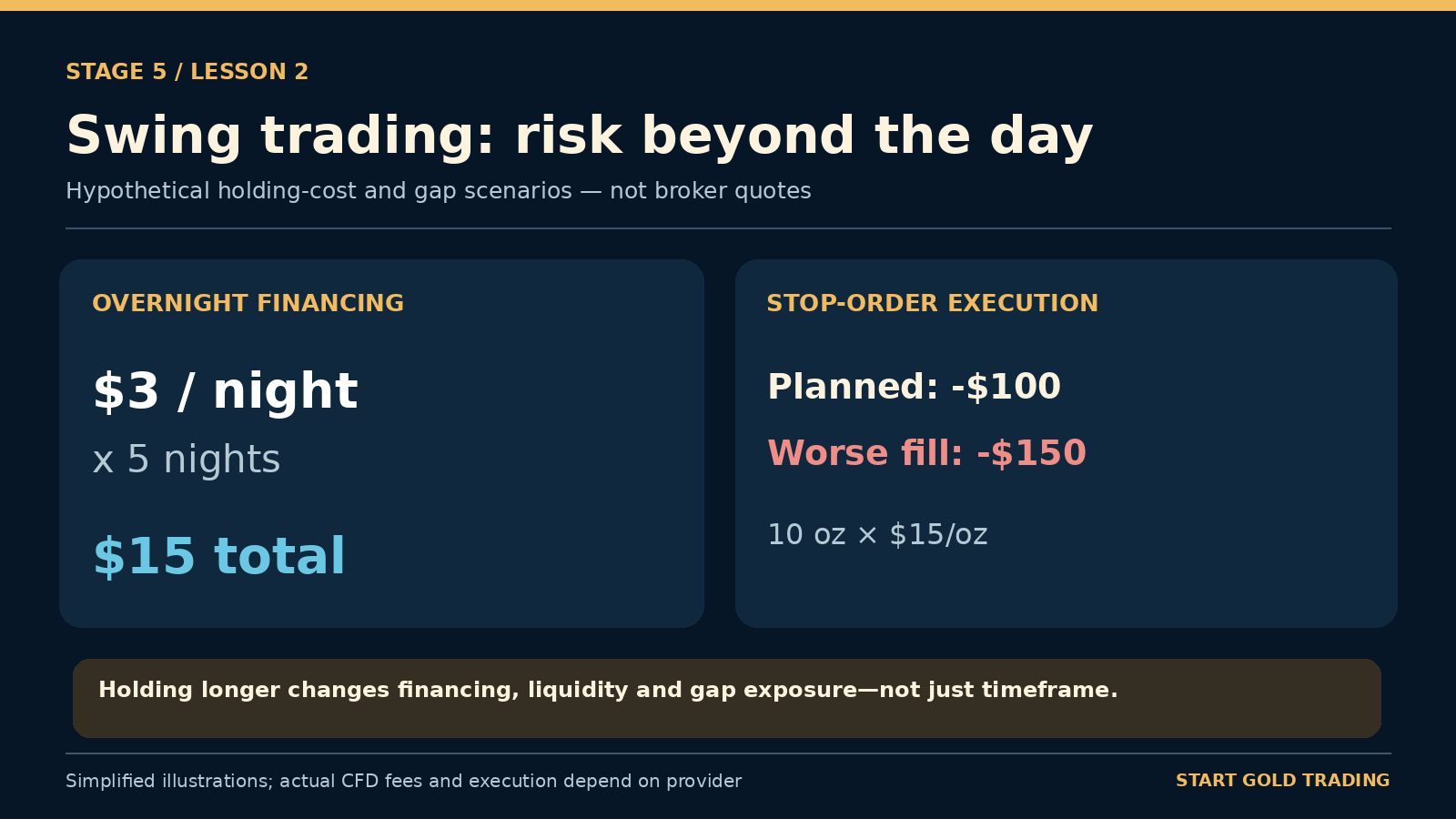
Suppose a long position representing 10 ounces has a planned stop trigger $10 below entry. A fill exactly at the trigger implies a $100 gross loss. If a gap or thin quotations produce an executable exit $15 below entry, gross loss would be $150, excluding spreads and fees. This is a hypothetical execution illustration, not a maximum-loss estimate.
Financing costs across several nights
For illustration only, assume a provider charged a total of $3 per night to hold a position for five nights. That would be $15 in holding charges before other costs. Actual overnight financing is often calculated using notional exposure, benchmark rates, adjustments and special weekend rules. Confirm the schedule with the provider rather than treating this flat illustration as a published rate.
| Holding consideration | Day trade | Swing trade |
|---|---|---|
| Exposure past daily close | Usually no | Often yes |
| News and weekend gaps | Depends on exit and product | Potentially material |
| Provider financing | Product-dependent | Can accumulate |
| Monitoring and maintenance margin | During live trade | Throughout holding period |
Use a repeatable swing-trade checklist
- Specify the instrument and its expiry or financing rules.
- Use only indicators and breakouts with precisely defined historical criteria.
- Quantify planned risk per ounce before considering available leverage.
- Stress-test a fill worse than the stop trigger.
- Record all financing and commissions against potential gains.
- Review whether the position would remain suitable after a large overnight gap.
How to evaluate a strategy
Use date-aligned price and cost data, avoid choosing support or resistance with hindsight, and test across both trending and sideways periods. CFA Institute’s backtesting discussion outlines the limitations of historical simulations and the need to interpret assumptions.
Key takeaway
Swing trading reduces some intraday decisions while introducing additional holding risk. A longer timeframe does not make a technical signal more reliable or protect a leveraged position from loss.
Sources
Continue learning
- Gold Trading for Beginners — Five-Stage Learning Guide
- Gold Scalping and Day Trading: Costs and Risks
- Long-Term Gold Investing: Bullion, Funds and Risk
Educational content only; not personal investment advice. All examples are hypothetical unless explicitly identified as dated historical research. Leveraged gold products involve substantial risk.