

Finishing an introductory gold trading course gives you vocabulary, not a licence to assume you can predict prices. A responsible next step is to examine what you know, what remains uncertain and whether a chosen instrument fits your financial circumstances. The goal is to develop sound questions and measurable decision habits, not to rush toward increasingly leveraged trading.
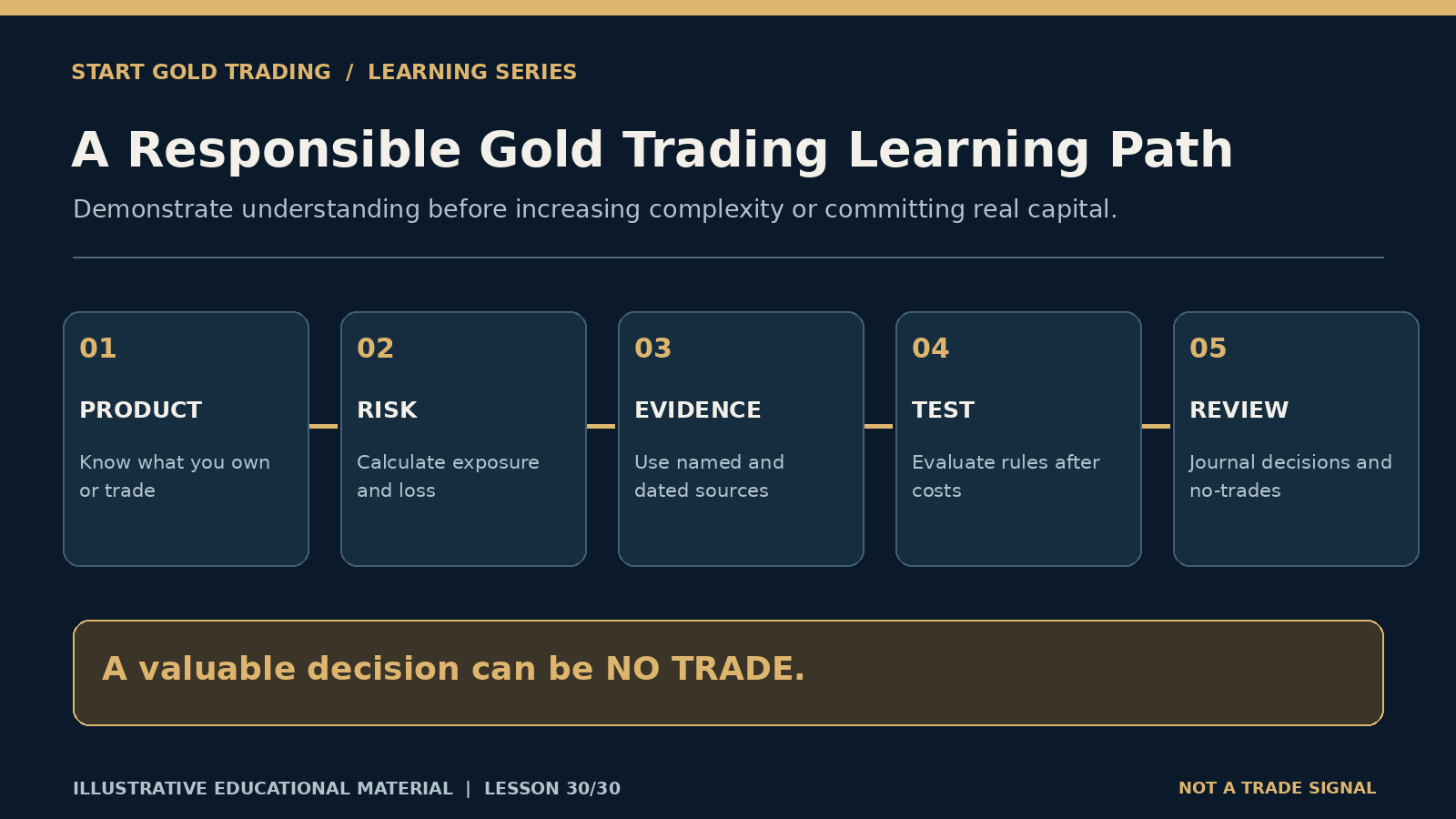
Milestone 1: Explain the products without jargon
- Explain the difference between physical bullion, gold-linked funds, listed futures and an OTC gold CFD.
- Identify who is your contractual counterparty and whether you own gold.
- Calculate the dollar result of a price move given ounces of exposure.
- List spread, commission, financing, slippage and possible liquidation risks.
Milestone 2: Read primary market information
Identify the specific quote and data feed on a chart, the schedule of key economic releases, and the difference between CFTC futures positioning and OTC spot gold liquidity. Separate a dated factual observation from a forecast or a social-media interpretation.
Milestone 3: Design a testable—not predictive—rule
Write down an observable entry condition, a separate invalidation condition, an exit process and permitted account exposure. Evaluate the complete rule on a known sample, then reserve later data for a fair test. CFA Institute describes backtesting and its bias risks.
Milestone 4: Track actual execution and decisions
Use a journal for both completed trades and decisions not to trade. Check actual broker statements and fees against theoretical chart returns. A trader who follows a well-defined rule can lose money; an impulsive lucky outcome is not evidence of a good process.
Milestone 5: Know when not to trade
- When a broker’s contract terms cannot be independently understood.
- When spreads or liquidity are unsuitable for the intended strategy.
- When risk is oversized relative to available capital.
- When a strategy’s data or test process is unreliable.
- When you feel compelled to chase losses or depend on trading profits for necessary living expenses.
A simple learning roadmap
| Learning step | Evidence of understanding |
|---|---|
| Gold markets and contracts | Can describe ownership, notional size and counterparty |
| Risk calculations | Can calculate planned loss and an adverse fill scenario |
| Market research | Can reference source, observation time and scope |
| Strategy test | Can explain the rules, costs, bias and unseen validation |
| Decision journal | Can distinguish decisions from market luck |
Careful with paid mentors, bots and communities
Training qualifications or polished trading screenshots do not prove a strategy works. Check whether a mentor or service provider is appropriately authorised where relevant and scrutinise returns after costs. The CFTC warns about guaranteed AI-bot returns and the MAS Financial Institutions Directory can support due diligence; neither creates a guarantee against losses.
Complete the guide without rushing
Revisit the parts of the course that are uncertain, practise calculations on fictional examples and avoid using real funds to test unknown platform behaviour. Further learning may include deeper market structure, data analysis and programming—but additional complexity should be justified by evidence.
Key takeaway
Better trading education should produce more accurate risk assessment and clearer evidence standards, not confidence unsupported by results. A sensible outcome of learning may be choosing not to trade.
Sources
- CFA Institute — Backtesting and Simulation
- CFTC — AI Won’t Turn Trading Bots into Money Machines
- MAS — Financial Institutions Directory
Continue learning
Educational information only. Market scenarios and calculations are hypothetical unless explicitly sourced. Gold and leveraged derivatives can involve substantial losses. This article is not personal investment advice.