
Gold traders encounter numerous charts, calendars, online communities and automated indicators. More tools do not automatically mean better information. A useful research kit starts with primary sources, contract specifications, dated observations and independent verification. The right source depends on whether you are examining physical gold, OTC CFDs or exchange-traded futures.
1. Check the exact instrument and contract
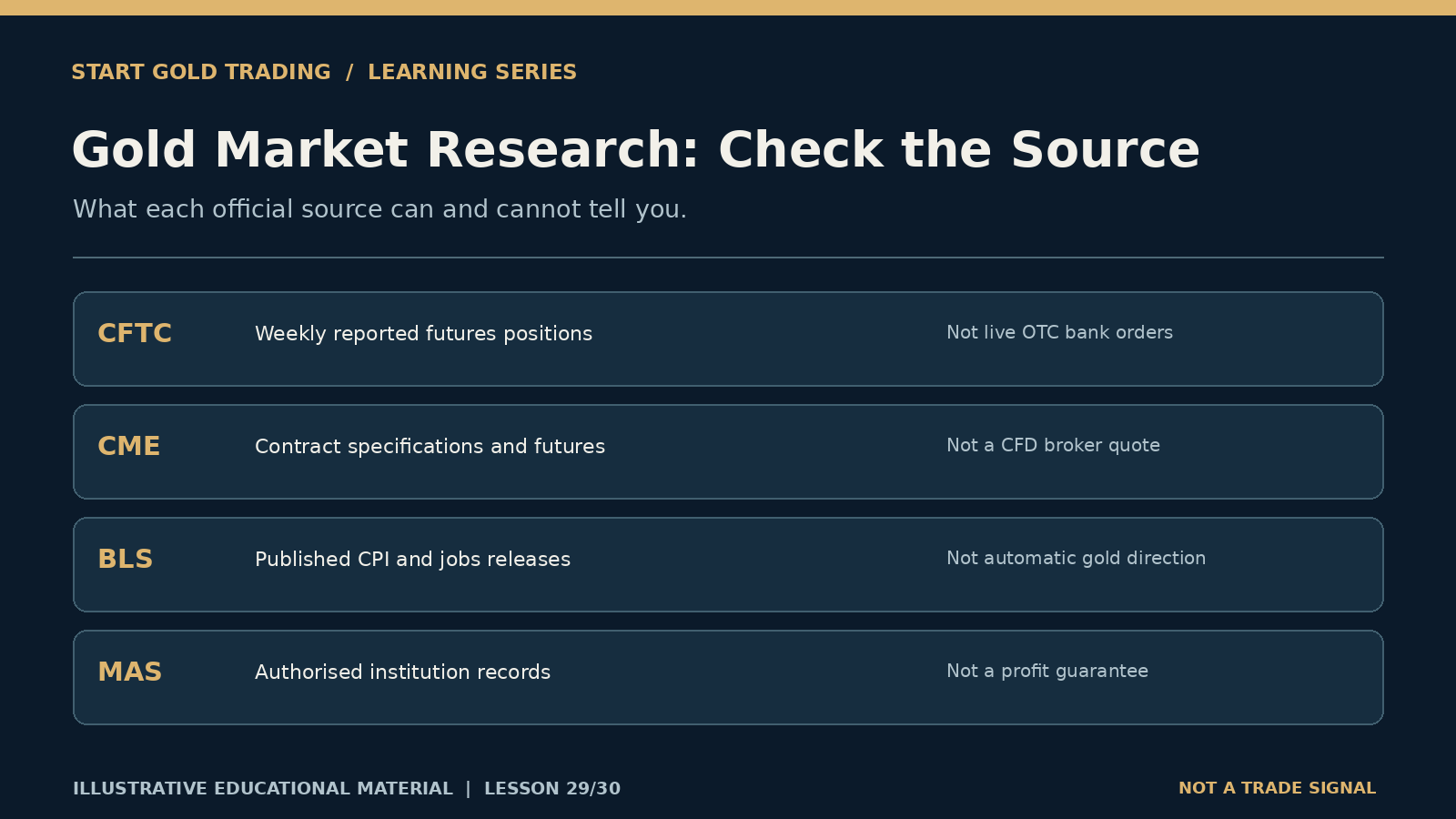
The CME Group gold futures page documents the exchange-traded gold contract and its contract specifications. Standard COMEX gold futures are not the same product as a retail XAU/USD CFD. Confirm ounces per contract, expiry, venue hours, minimum price increment and which price feed your chart uses.
2. Use the official CFTC Commitments of Traders reports
The CFTC Commitments of Traders portal and Disaggregated Futures Only dataset show reportable positioning by trader categories, including Managed Money, Swap Dealers, Producer/Merchant/Processor/User and Other Reportables. Check the specific COMEX gold contract and positions-as-of date. These are weekly reported futures positions, not a live global map of spot-gold bank orders.
3. Read official economic calendars and source releases
- Inflation: consult the US Bureau of Labor Statistics CPI release calendar and complete release.
- Employment: check the official Employment Situation calendar and related revisions.
- Market reaction: compare release against a clearly sourced, timestamped expectation and observe dollar/yield moves; never invent consensus values.
4. Verify the provider and fees
For a Singapore-based investor, the MAS Financial Institutions Directory allows a check of regulated entities and their permitted activities. Confirm that the exact legal entity offering an account is the one shown in official records. Regulation does not guarantee profits or protect against every loss. Review spreads, commissions, overnight financing, liquidity, withdrawal conditions and client-money arrangements.
5. Understand what chart and volume data show
| Data type | What it can show | Limit |
|---|---|---|
| OTC CFD quote | Provider-specific bid, ask or indicative price | Not a single global executed gold price |
| Exchange futures volume | Contracts actually traded on that exchange | Not total OTC gold activity |
| COT report | Weekly reportable futures positioning | Not tick-by-tick trader intentions |
| Economic release | A published macroeconomic statistic | Market response depends on expectations |
| Broker statement | Actual fills, costs and balances for your account | Must be reconciled with trading journal |
6. Build simple and useful research tools
- Maintain a timestamped watchlist of gold, dollar and relevant yield data.
- Record known scheduled macro releases and contract holiday sessions.
- Calculate ounces of exposure, notional value and dollar impact per $1/oz move.
- Export broker fills and compare execution prices with planned risk.
- Keep a change log for any indicator or strategy hypothesis.
- Save links to primary sources rather than relying on forwarded screenshots.
7. Treat online communities as unverified discussion
Forums and social media may help identify questions worth investigating, but comments are not independently verified institutional order flow. Investor.gov warns about internet and social media fraud. Beware messages promising guaranteed returns, paid trading signals with unverifiable records, or pressure to send funds to unknown parties.
Key takeaway
A modest set of dependable sources is better than dozens of unverified dashboards. Know which data covers what market, how often it updates, and what it cannot prove.
Sources
- CFTC — Commitments of Traders
- CFTC — Disaggregated Futures Only Data
- CME Group — Gold Futures
- MAS — Financial Institutions Directory
- BLS — CPI Release Schedule
- BLS — Employment Situation Release Schedule
- Investor.gov — Internet and Social Media Fraud
Continue learning
- Gold Trading for Beginners — Five-Stage Learning Guide
- Gold Trading Journal: Practical Review
- Gold Trading: Next Steps for Learning
Educational information only. Market scenarios and calculations are hypothetical unless explicitly sourced. Gold and leveraged derivatives can involve substantial losses. This article is not personal investment advice.