

A trading journal is a structured record of what a trader planned, what orders actually executed and what happened afterward. Its main purpose is better evidence and decision review, not guaranteed profits. It should include skipped trades and errors as well as wins.
Record the instrument and market context
- Time and timezone: record a complete timestamp, such as Singapore time (UTC+8), and the market’s local time if relevant.
- Product: broker or exchange, XAU/USD CFD versus futures, lot-to-ounce specification and bid/ask convention.
- Context: major scheduled releases, observed spread and volatility at decision time.
- Setup: exact entry trigger, invalidation and reasons to stay out.
- Exposure: notional size, margin used, chosen planned risk budget and outstanding correlated positions.
Plan versus actual execution: worked example
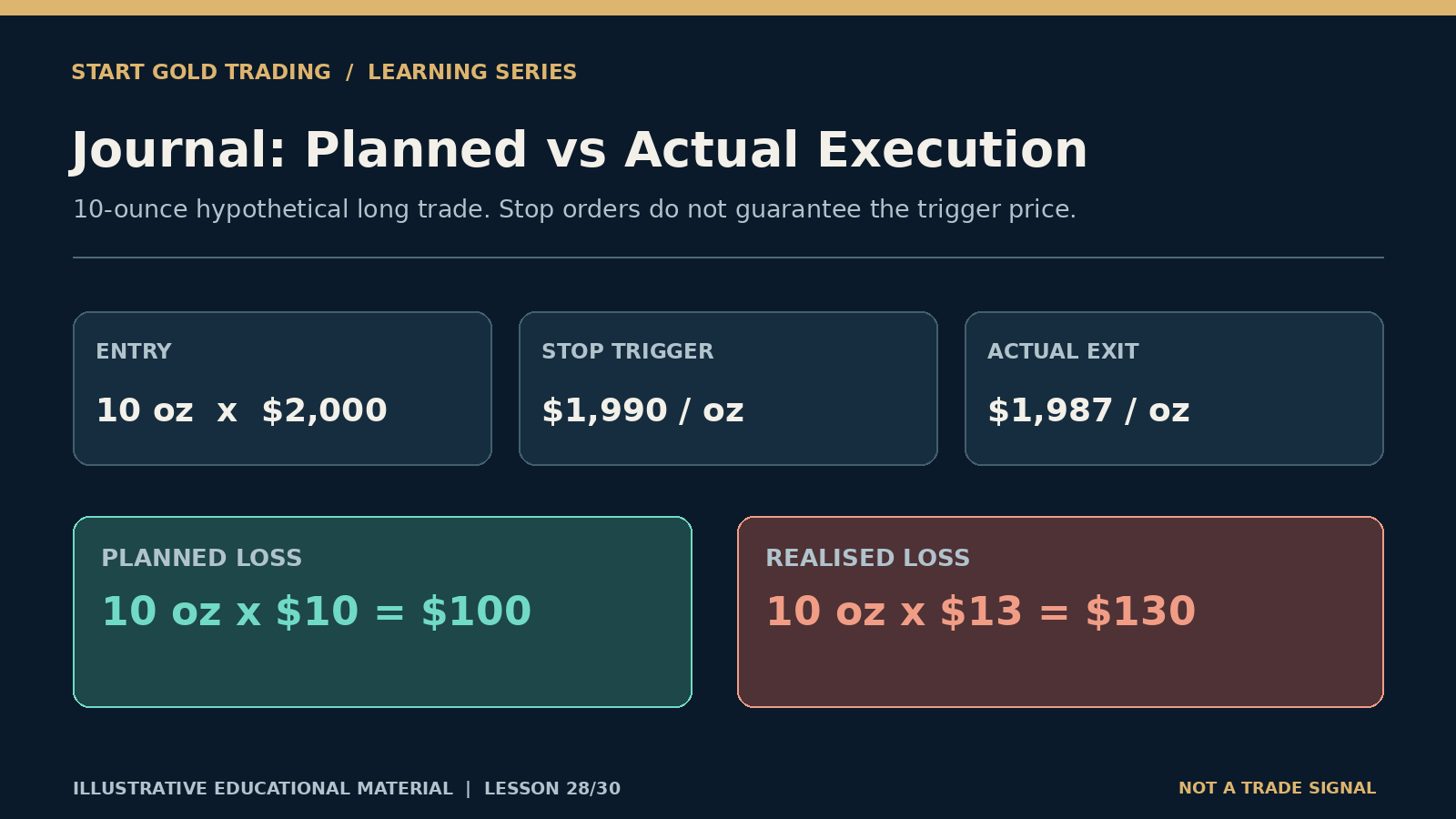
Suppose a hypothetical gold CFD long represents 10 ounces, has an entry at $2,000/oz and a stop trigger at $1,990/oz. If the position exits at $1,987/oz during a volatile market, its actual price loss is larger than the planned figure.
| Journal field | Hypothetical record |
|---|---|
| Entry and position size | Long 10 oz at $2,000/oz |
| Planned stop | $1,990/oz |
| Planned gross loss at stop | 10 × $10 = $100 |
| Actual exit | $1,987/oz |
| Realised gross loss | 10 × $13 = $130 |
| Slippage versus planned stop | $30 worse, before fees |
Add spread, commission, financing and currency conversions separately to calculate the net account outcome. These figures are hypothetical, not historical gold quotes or a guarantee that slippage is limited to $3.
A reusable journal structure
| Category | Fields to record |
|---|---|
| Before trade | Date/time, instrument, setup, risk budget, planned order |
| During trade | Submitted orders, fills, adjustments, rejected orders |
| After trade | Actual gross and net result, costs, MFE/MAE when reliably available |
| Process review | Were prewritten rules followed? If not, why? |
| No-trade observation | Setup considered, why skipped, what later occurred |
| Evidence | Screenshots plus export of broker execution report |
Why skipped trades belong in the journal
Only logging positions actually opened hides opportunities rejected by the rules. A skipped trade can be the correct decision, especially during news spikes or wide spreads. Record decisions at the time rather than reconstructing a convincing rationale after the chart has moved.
A simple weekly review routine
- Reconcile journal rows with official broker executions and balances.
- Separate strategy-rule adherence from lucky or unlucky outcomes.
- Group trades by predefined characteristics such as session, strategy and execution quality.
- Compare costs and slippage by instrument and market condition.
- Identify a small number of questions for later testing, rather than rewriting every rule.
- Maintain a clearly dated version of any strategy change.
Limits of journal statistics
A journal is an observational dataset with sample bias, dependence between trades and changing market conditions. A handful of wins after a certain candle pattern does not establish statistical reliability. CFA Institute’s backtesting guidance explains how testing choices can distort apparently promising results.
Key takeaway
A useful journal answers: what was planned, what was executed, what did it cost, and what evidence should be gathered next? It should describe decisions accurately instead of promising positive returns.
Sources
Continue learning
- Gold Trading for Beginners — Five-Stage Learning Guide
- Evaluating a Gold Trading Strategy: Metrics and Risks
- Essential Gold Trading Resources and Data
Educational information only. Market scenarios and calculations are hypothetical unless explicitly sourced. Gold and leveraged derivatives can involve substantial losses. This article is not personal investment advice.