

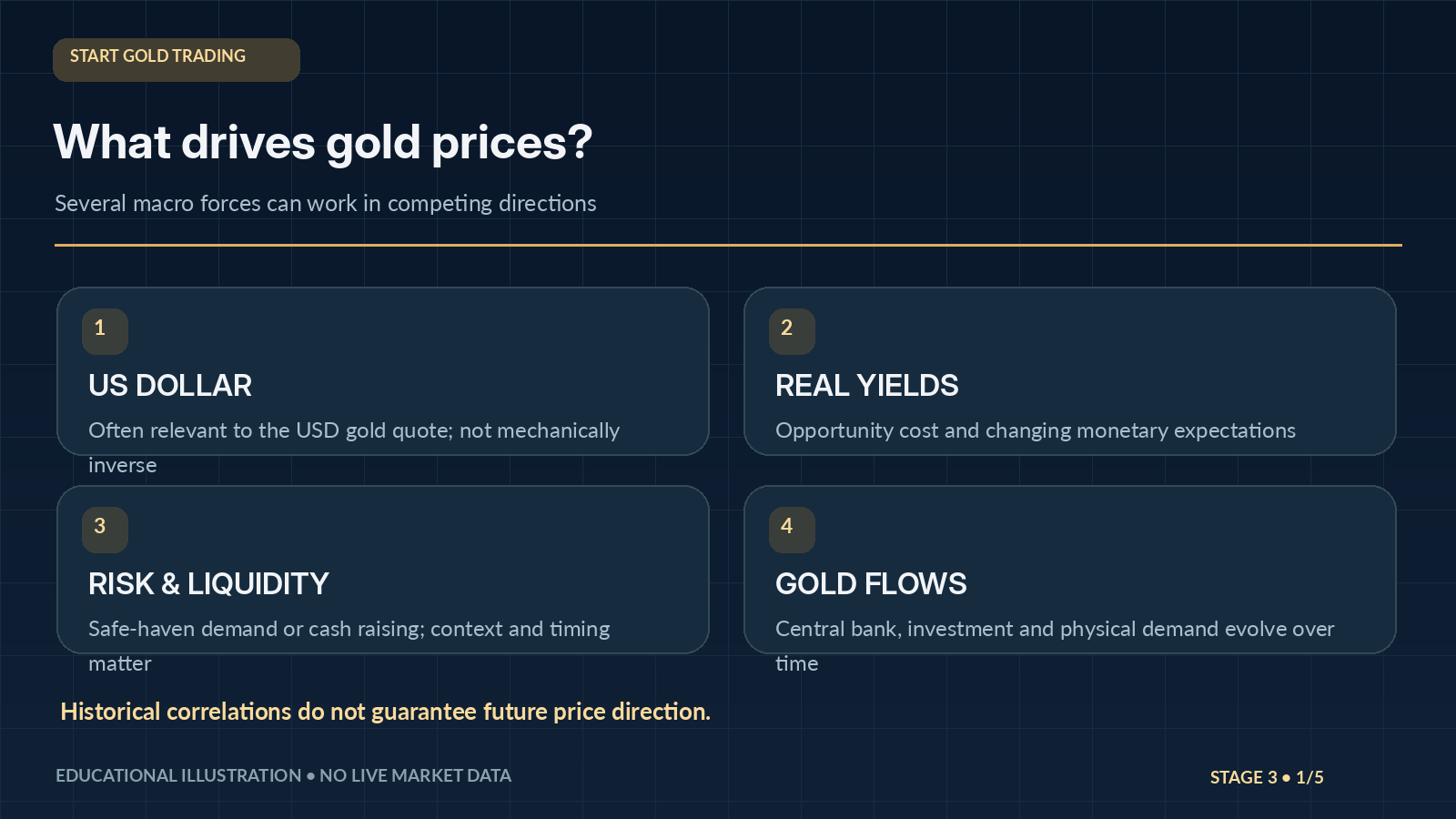
Understanding what moves gold prices is different from knowing where the next XAU/USD candle will close. Gold reflects competing influences: the US dollar, bond yields, monetary expectations, risk appetite, investor flows and physical demand. The relationship changes over time. A disciplined fundamentals review therefore uses conditional explanations, not a single bullish or bearish formula.
Gold is priced in dollars, but there is no fixed USD rule
Global gold reference quotations commonly use US dollars per troy ounce. When the dollar strengthens, gold can become more expensive for investors using other currencies, sometimes weighing on demand. But gold and the dollar may rise together when both attract safe-haven buying, or when other drivers dominate. Historical correlations are observations, not trading guarantees. The World Gold Council describes the changing gold–dollar relationship.
Nominal yields versus real yields
A nominal Treasury yield is expressed before accounting for inflation. A market-based real yield reflects a yield on inflation-protected securities and is commonly monitored as one measure of the opportunity cost of holding non-interest-bearing bullion. The FRED DFII10 series tracks a 10-year US inflation-indexed Treasury constant-maturity yield. It is not a guarantee of future realised purchasing-power returns, nor a direct measurement of all investor opportunity costs.
Rising real yields can pressure gold in some environments, while falling real yields may support it. Both correlations and effects vary over time, so avoid assuming a 10-basis-point yield change produces a fixed dollar change in gold.
Inflation: expectations matter more than a headline alone
A high inflation reading can increase interest in gold as a store of value, but it can also raise expectations for tighter central-bank policy and higher yields. The same data can generate competing reactions. Compare the actual release to economists’ expectations, prior revisions and market positioning before explaining a movement; a high CPI number alone is not an automatic signal to buy.
Four interacting drivers
| Factor | Possible channel | Important caveat |
|---|---|---|
| US dollar | Changes non-USD gold purchasing power | Gold and USD can move together |
| Nominal and real yields | Change opportunity cost and policy expectations | Reaction depends on why yields moved |
| Risk and liquidity | Safe-haven demand or forced asset sales | Gold can decline during liquidity shocks |
| Investment and physical flows | ETF, central-bank and wholesale/physical demand | Flow effects are not identical across timeframes |
Why geopolitical headlines can produce two-way volatility
During conflict or financial stress, gold may attract precautionary demand. Yet stressed investors sometimes sell liquid assets to obtain cash or meet margin calls. Dollar funding and yields may also move sharply. A price reversal after a dramatic headline does not disprove gold’s safe-haven role; it shows that several forces are operating simultaneously.
How to prepare a daily fundamental brief
- Record the observation timestamp and the source for spot gold and the relevant futures quote; do not mix a CFD provider’s quote with a central exchange contract.
- Check dollar trends, nominal US Treasury yields and an appropriate real-yield proxy.
- Identify upcoming CPI, employment, central-bank events and the prevailing consensus.
- Separate facts, interpretations and conditional scenarios. Example: what if gold and the dollar both rise?
- Define what observation would change your thesis instead of claiming a certain next move.
Learning checkpoint
Suppose nominal yields rise and gold rises too. Rather than rejecting the data, investigate whether inflation expectations, risk aversion, central-bank demand or currency dynamics also changed. This is a research question, not a live trading instruction.
Key takeaway
Macroeconomic indicators are useful context for gold, not a stand-alone price prediction engine. Compare more than one driver and remain open to contradictory outcomes.
Sources
- World Gold Council — Why rates and USD alone cannot explain gold
- FRED — 10-Year Inflation-Indexed Treasury Yield
- World Gold Council — Gold and the US Dollar
Continue learning
- Gold Trading for Beginners — Five-Stage Learning Guide
- Technical Analysis for Beginners: Mastering Gold Trading Charts
- Candlestick Patterns Explained: Decoding Gold Price Charts
Educational material only. Hypothetical examples are not current market quotes or recommendations. Gold and leveraged derivatives involve a risk of significant loss.