

An effective gold-trading mindset is a method for making decisions when the next price move is unknown. Patience, preparation and reflection can reduce avoidable errors; they cannot transform an untested strategy into a reliable source of income.
Why mindset is different from strategy profitability
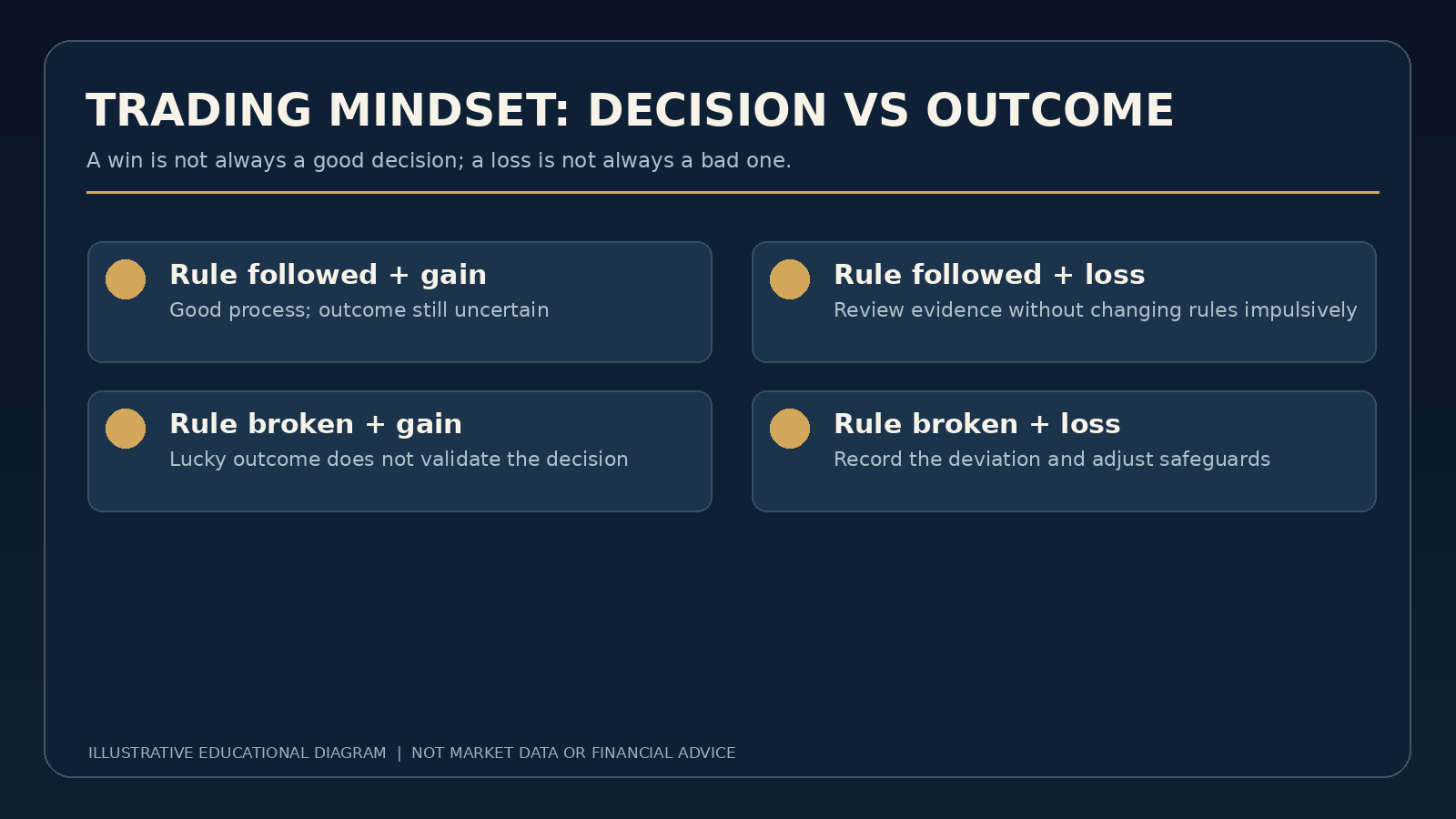
A trader can follow a clearly defined plan and lose money because the strategy had no statistical edge or market conditions changed. Conversely, an impulsive trade can occasionally make money. Track the decision process independently from its financial result: a lucky gain does not validate an error, and a planned loss does not automatically invalidate a careful decision.
Four habits worth measuring
- Preparation: confirm the gold instrument, legal provider, contract size, current spreads and scheduled news.
- Patience: write down what qualifies as a setup and what makes a no-trade decision appropriate.
- Evidence: separate a price observation from a forecast; review results over a meaningful sample, including costs.
- Recovery: after an unexpected loss, inspect fills and rule adherence instead of attempting to recover immediately.
Decision quality and financial results
| Decision | Profitable result | Losing result |
|---|---|---|
| Followed documented rules | Good process, but not proof of edge | Good process, review method and execution |
| Broke documented rules | Lucky outcome; correct the deviation | Correct the deviation, reassess exposure |
Common mental traps
- Recency bias: expecting the next gold candle to resemble the last few candles.
- Overconfidence: raising lot size after a few wins without fresh evidence.
- Confirmation bias: selecting only news that supports the current gold bias.
- Outcome bias: praising a broken rule because it happened to make money.
- FOMO: entering a volatile movement solely because it feels like a missed opportunity.
A five-minute preparation and review routine
- Identify the exact product and whether the chart is a CFD quote or an exchange contract.
- Record the market context, entry criteria and reasons to stay flat.
- Calculate intended exposure and an adverse-slippage scenario.
- Review the executed order and costs rather than assuming a chart price was fillable.
- Record the decision, including any choice to remain out of the market.
Know the limitations
In leveraged gold CFDs, actual losses can exceed the planned stop distance because orders may slip and margin can be closed out under provider rules. MoneySense explains these CFD risks. Investor.gov also warns about emotional and financial risks of day trading. Trading may be unsuitable for anyone who needs the funds for essential expenses.
Key takeaway
Judge preparation and decision discipline by observable evidence. Neither a calm mindset nor an attractive trading journal establishes guaranteed profitability.
Continue learning
Sources
Educational information only; none of the hypothetical examples constitute current market quotes, verified return expectations or financial advice. Leveraged trading carries substantial risks.