
Automated gold trading uses software to monitor an instrument and submit orders when predefined rules are met. This can make execution consistent with a written rule, but a computer cannot make an untested trading idea profitable. A bot can enter losing trades faster than a person, and outages or incorrect settings can multiply risk.
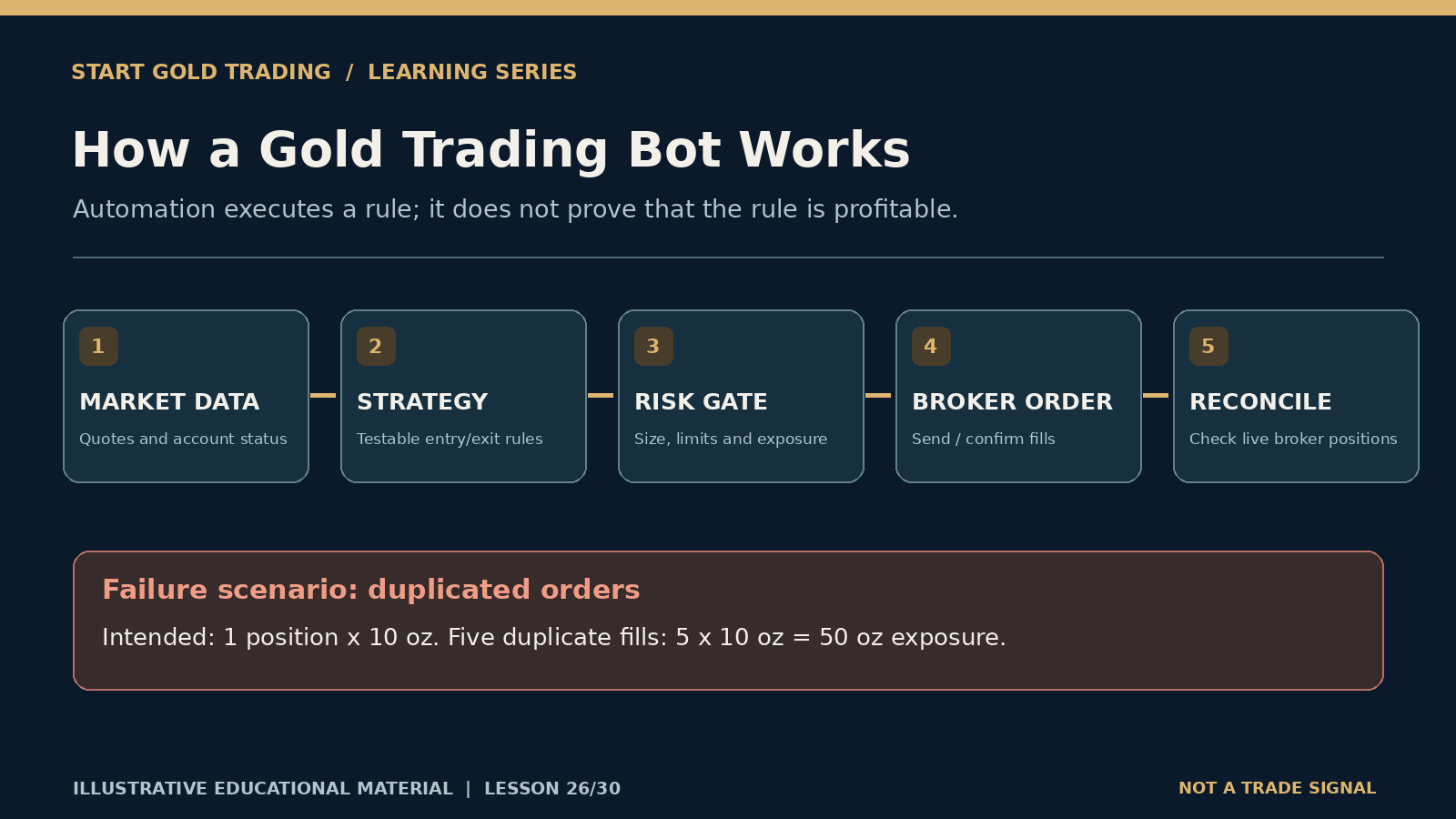
How an automated gold-trading system works
- Read prices and account details from a broker or exchange data connection.
- Calculate any conditions using past or current data without accidentally reading future candles.
- Check position size, margin, permitted time window and outstanding orders.
- Submit or cancel orders according to the configured rules.
- Confirm whether an order actually filled and reconcile positions.
- Log errors and alert an operator when quotes, orders or connections behave unexpectedly.
For an OTC gold CFD, the provider’s terms determine tradeable prices, lot sizes, execution and overnight charges. A platform alert or strategy backtest is not proof of an executable fill.
Potential operational benefits and the trade-offs
| Potential benefit | Related limitation |
|---|---|
| Repeatable rule execution | Repeatable errors and no guarantee of an edge |
| Fast monitoring of markets | Latency, outages, rejected orders and stale prices |
| Automated logging | Incorrect data or missing broker confirmations |
| Historical testing | Curve-fitting and hindsight bias |
| Reduced impulsive order entry | An unsafe algorithm can still take excessive risk |
A simple example of a dangerous automation error
Suppose a hypothetical bot is supposed to hold only one 10-ounce gold CFD position. A connectivity problem causes it to retry an entry five times without first checking whether previous orders were filled. If all five orders execute, total exposure could become 50 ounces—five times the intended exposure. This is an operational scenario, not a prediction about a particular platform.
Test the system, not just the trading signal
- Historical test: define the rules before calculating results; include bid/ask spreads, financing, commissions and missed fills.
- Out-of-sample and walk-forward testing: reserve later observations that were not used to tune parameters. CFA Institute explains limitations of backtests.
- Paper trading: confirm that event handling, order confirmations and broker-specific lot sizes work; simulated fills may still differ from live ones.
- Failure testing: simulate rejected orders, duplicate fills, stale quotes, disconnections and unexpected margin changes.
- Independent reconciliation: compare the bot’s recorded positions against the broker’s actual positions.
Safety controls to design before live use
- Set a maximum permitted notional exposure and number of open orders.
- Block duplicate client order IDs and handle retries idempotently.
- Set a daily risk budget and an emergency stop for new submissions.
- Alert a human to connection loss, pricing anomalies and unexpected fills.
- Keep broker credentials secure and restrict their permissions where supported.
- Have a documented shutdown and recovery procedure—without assuming it can always close a trade during an outage.
Beware of guaranteed AI-bot returns
The CFTC warns that AI and automated trading bots are not money machines. Claims of guaranteed monthly returns, secret algorithms, 100% win rates or pressure to transfer money to unfamiliar accounts are warning signs. An audited strategy needs independently understandable methodology, real execution evidence and consideration of risks—not screenshots, influencer endorsements or a demo-account equity curve.
Key takeaway
Automation changes the way orders are generated and managed. It does not remove uncertainty, counterparty risk or the need for independent testing, controls and oversight.
Sources
Continue learning
- Gold Trading for Beginners — Five-Stage Learning Guide
- Advanced Gold Charting: Fibonacci, Bollinger Bands and Ichimoku
- Evaluating a Gold Trading Strategy: Metrics and Risks
Educational information only. Market scenarios and calculations are hypothetical unless explicitly sourced. Gold and leveraged derivatives can involve substantial losses. This article is not personal investment advice.