

Gold markets move quickly around news and liquidity shocks, which can make it tempting to chase prices, increase position size or abandon a trading plan. Emotional awareness is useful when paired with observable pre-trade rules and the choice to stay out.
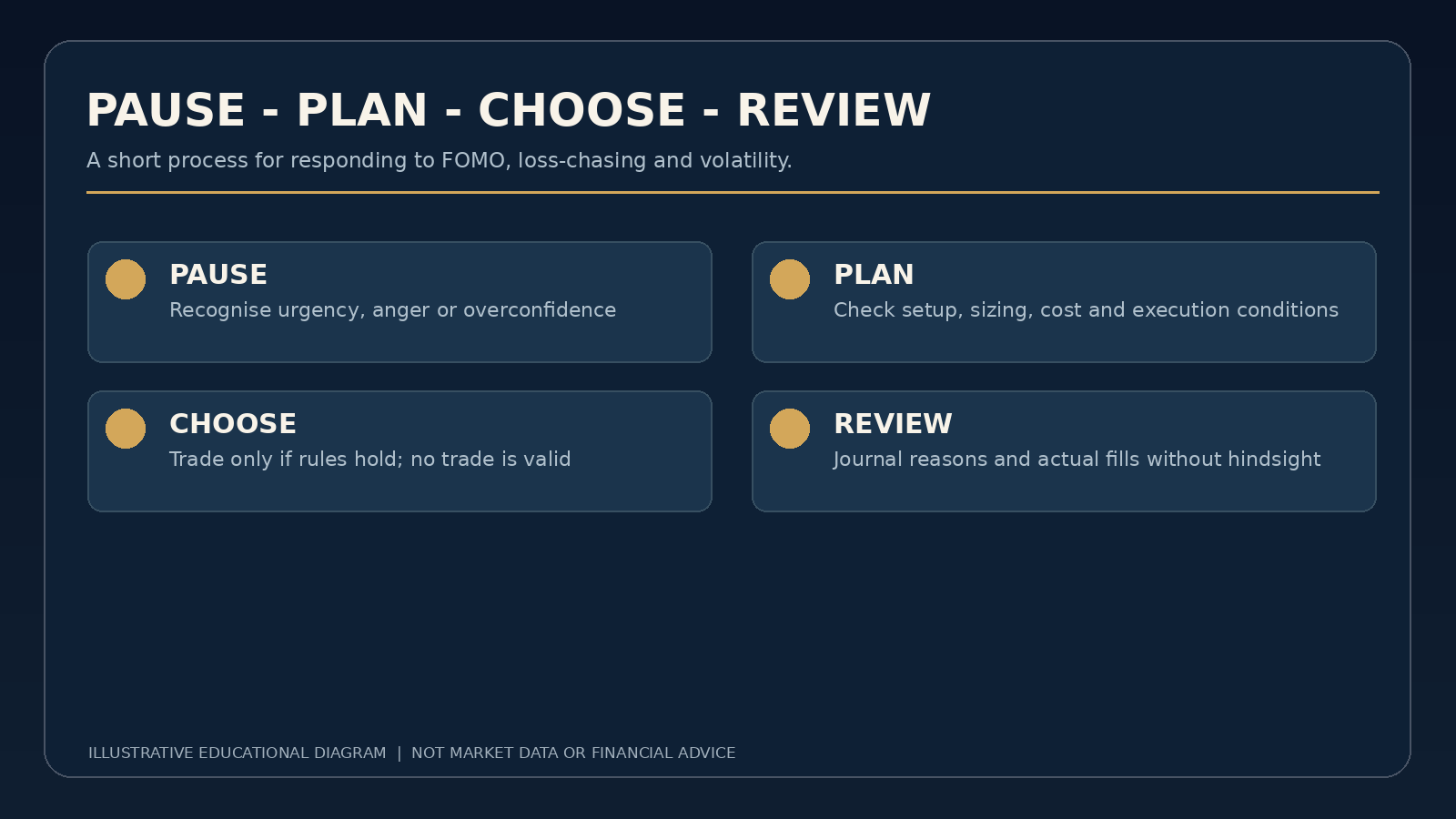
Notice the trigger before placing an order
Three common triggers are chasing a large gold candle after a news release, adding positions to recover a previous loss, and increasing lot size after an unusually good session. The existence of an emotional response is not a diagnosis or proof that a particular trade will lose; it is a reason to check the planned decision conditions.
Pause, plan, choose, review
- Pause: ask whether the proposed trade is in the written plan or an impulse caused by the last candle or P/L.
- Plan: verify the instrument, entry condition, intended exposure, order type and spread.
- Choose: submit an order only if documented conditions hold; otherwise remain flat.
- Review: record the reason, actual fill and any deviation after the event.
Hypothetical news-day decision
Suppose XAU/USD moves $15 per ounce immediately after a US economic release. A trader sees the surge and wants to enter, but the plan prohibits new positions while the provider’s spread is unusually wide. They choose not to trade and record the observation. If gold then rises further, the no-trade decision was still consistent with the predetermined execution limits.
When a position is already open
An active CFD may require monitoring even when the trader is uncomfortable. Acting solely to remove discomfort can conflict with a tested exit procedure, but ignoring margin and execution risks is also unsafe. Stop orders do not guarantee a specific price, and providers may liquidate positions after margin shortfalls. See MoneySense’s CFD risk guide.
A useful journal prompt
| Timing | Question |
|---|---|
| Before trade | What evidence and rule prompted this decision? |
| During volatility | Did the quote/spread and order behaviour meet conditions? |
| After trade or no-trade | Did I follow the recorded plan? |
| Weekly review | Are patterns emerging across enough observations? |
Original embedded video
The video originally embedded in this article remains below for editorial review. Verify its continued availability, accuracy and appropriateness before approving the revised article.
Know when to step away
Stepping away from the screen or pausing new orders can be a useful boundary when repeated trades are driven by urgency, anger or attempts to win back losses. No particular psychological exercise guarantees safer or profitable trading. Investor.gov warns of the pressures and financial risks of rapid trading.
Key takeaway
The objective is not to trade without emotion. It is to make the reasons, constraints and outcomes of each decision observable and reviewable.
Continue learning
Sources
Educational information only; none of the hypothetical examples constitute current market quotes, verified return expectations or financial advice. Leveraged trading carries substantial risks.