
Choosing a gold CFD broker is not primarily about finding the slickest trading app or the tightest advertised spread. You are selecting a contractual counterparty whose terms, pricing, execution and regulatory status can affect your results and your ability to withdraw funds. Start by checking the exact legal entity—not just the brand name.
1. Identify the legal entity and verify permissions
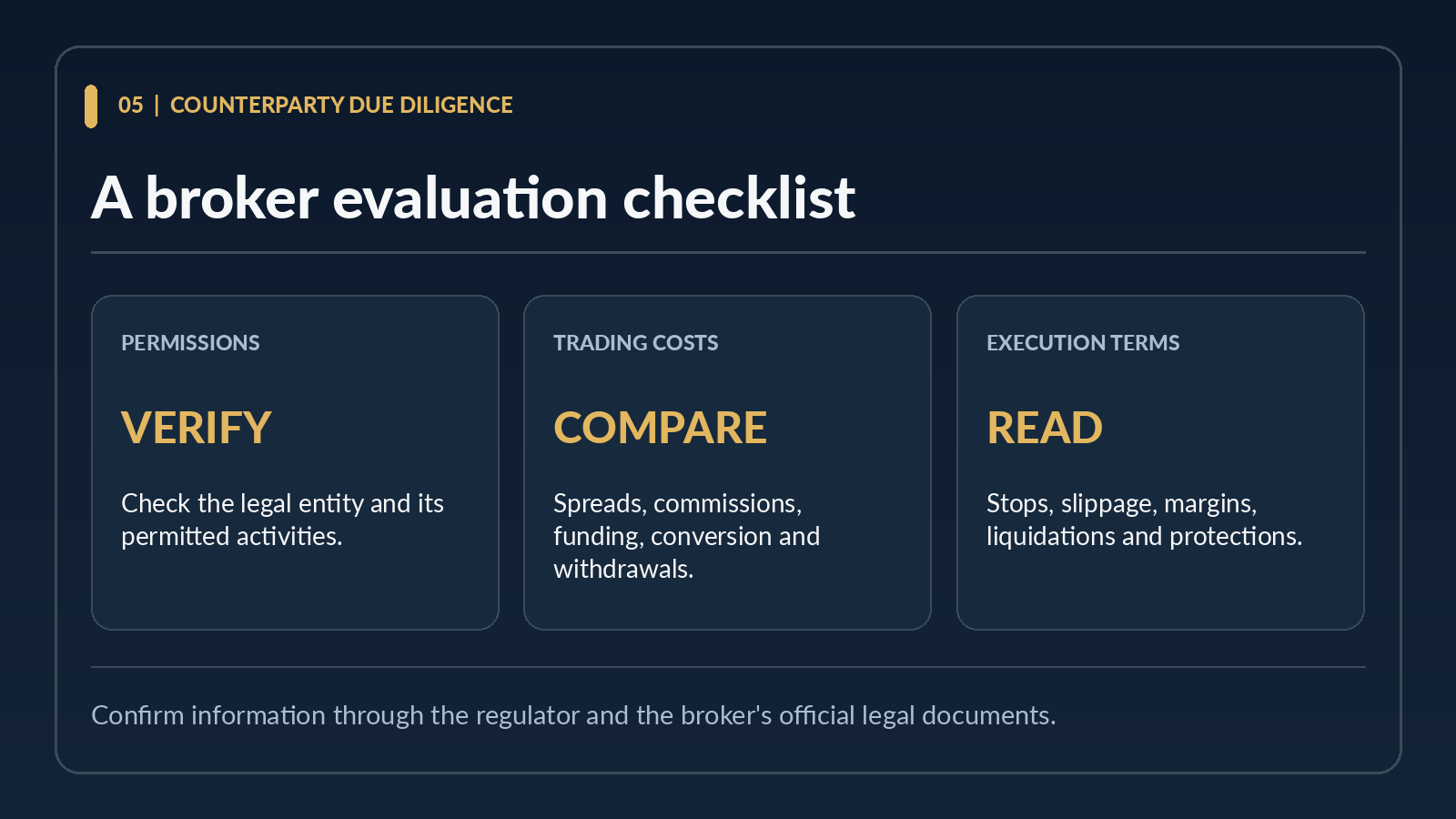
Find the full registered name in the proposed account agreement and check the regulator’s official register for that specific entity. In Singapore, use the MAS Financial Institutions Directory to check the firm and relevant regulated activities. An international group can have several affiliates with different authorisations, protections and account terms.
An apparently familiar brand name or a licence in one country does not mean your account is held with that country’s regulated entity. Confirm which company owes you money, which law governs disputes, and what investor protections—if any—apply. Registration is not a guarantee against insolvency, misconduct or trading losses.
2. Understand the actual product you will trade
- Instrument details: determine whether you are entering a gold CFD, a rolling spot-style OTC derivative or a listed futures contract.
- Contract size: confirm troy ounces per lot/unit, minimum trade size and price-step convention.
- Quotes and execution: ask where the broker derives prices and how it handles orders outside normal liquidity.
- Risk disclosures: read the margin, financing, cancellation and close-out sections—not just marketing material.
3. Compare total trading costs, not just headline spreads
A bid/ask spread is usually the difference between the prices at which you can buy and sell at one moment. Trading may also involve commissions, overnight funding, currency conversion, inactivity or withdrawal fees. A spread advertised as ‘from’ a low value may not reflect typical costs during busy or stressed periods.
| Cost item | Question for the broker |
|---|---|
| Spread | Typical and stressed spreads for the exact gold instrument? |
| Commission | Per side, per lot or incorporated in the quoted spread? |
| Financing | Rate, daily cutoff, weekend adjustments and calculation basis? |
| FX conversion | Fee if your account and product settle in different currencies? |
| Other charges | Deposit, withdrawal, inactivity and account fees? |
Hypothetically, a $0.40-per-ounce bid/ask spread across 10 ounces represents $4 of spread exposure if the mid-price remains unchanged and you immediately open and close. This is a simplified illustration; actual transaction costs depend on changing quotes, commissions and order handling.
4. Inspect margin and stop-order policies
Look up the initial and maintenance margin levels, the mechanism for margin calls, forced liquidation thresholds and the rules during news events or market closures. Check whether stop orders have guaranteed or non-guaranteed execution and whether the provider may re-quote, reject or slip an order. See MoneySense’s explanation of CFD risks and FCA’s CFD consumer guidance.
5. Check client-money handling and applicable protections
Read how client funds are held, whether the provider is acting as principal, the insolvency treatment of client assets, and which dispute resolution channels cover your account. Negative-balance protection, maximum leverage and other retail safeguards depend on location and account classification. Do not assume that choosing professional status improves consumer safeguards; it may reduce them.
6. Test the operational experience without depositing substantial funds
- Verify the entity’s name and contact details against official regulatory information; watch for impersonators.
- Read and save the account agreement, fee schedule, execution policy and risk disclosure.
- Examine a demo account to understand order entry, stop rules, position size and reporting.
- Check customer support responsiveness, account statements and complaint procedures.
- Only consider an account suitable after reviewing your eligibility, product knowledge and financial ability to bear losses.
Account opening and Singapore considerations
CFDs are classified as unlisted Specified Investment Products in Singapore. Under the relevant framework, a provider conducts a Customer Knowledge Assessment (CKA) before an eligible retail client can trade these products. Other regions have different requirements. The exact onboarding process may include identity checks, financial information and product appropriateness assessments; passing checks does not make the product low risk.
Key takeaway
Compare brokers using a documented checklist: legal entity, authorisation, contract details, total costs, execution policy, margin treatment and customer safeguards. Broker selection can reduce avoidable operational risks, but it cannot turn a leveraged CFD into a safe investment.
Sources
- MAS — Financial Institutions Directory
- MoneySense — Understanding Contracts for Difference
- FCA — Contracts for Difference
Course navigation
Gold Trading for Beginners — Five-Stage Learning Guide
- Related chapter: the advantages of gold trading why invest in gold
- Related chapter: technical analysis for beginners mastering gold trading charts
Educational information only. All numerical trading examples are hypothetical, exclude fees unless stated, and are not personal financial advice. Gold and leveraged derivatives can produce substantial losses.