
A gold trading course should help a learner understand instruments, quotations, price data and risk—not promise income. Many paid courses advertise impressive past trades or proprietary signals; neither establishes that the material is accurate or that students will profit. This guide compares educational formats and offers a course evaluation checklist that can be used before paying for a programme.
1. Decide what skill you need to learn
Some beginners need a plain-English introduction to bullion, funds and CFDs, while others want to understand exchange futures, macroeconomic releases or backtesting. Courses focused only on a supposed winning signal may skip essential contract literacy. Start by writing two or three skills you want to demonstrate, such as explaining bid/ask prices or calculating loss for ten ounces of exposure.
2. Compare the teaching formats
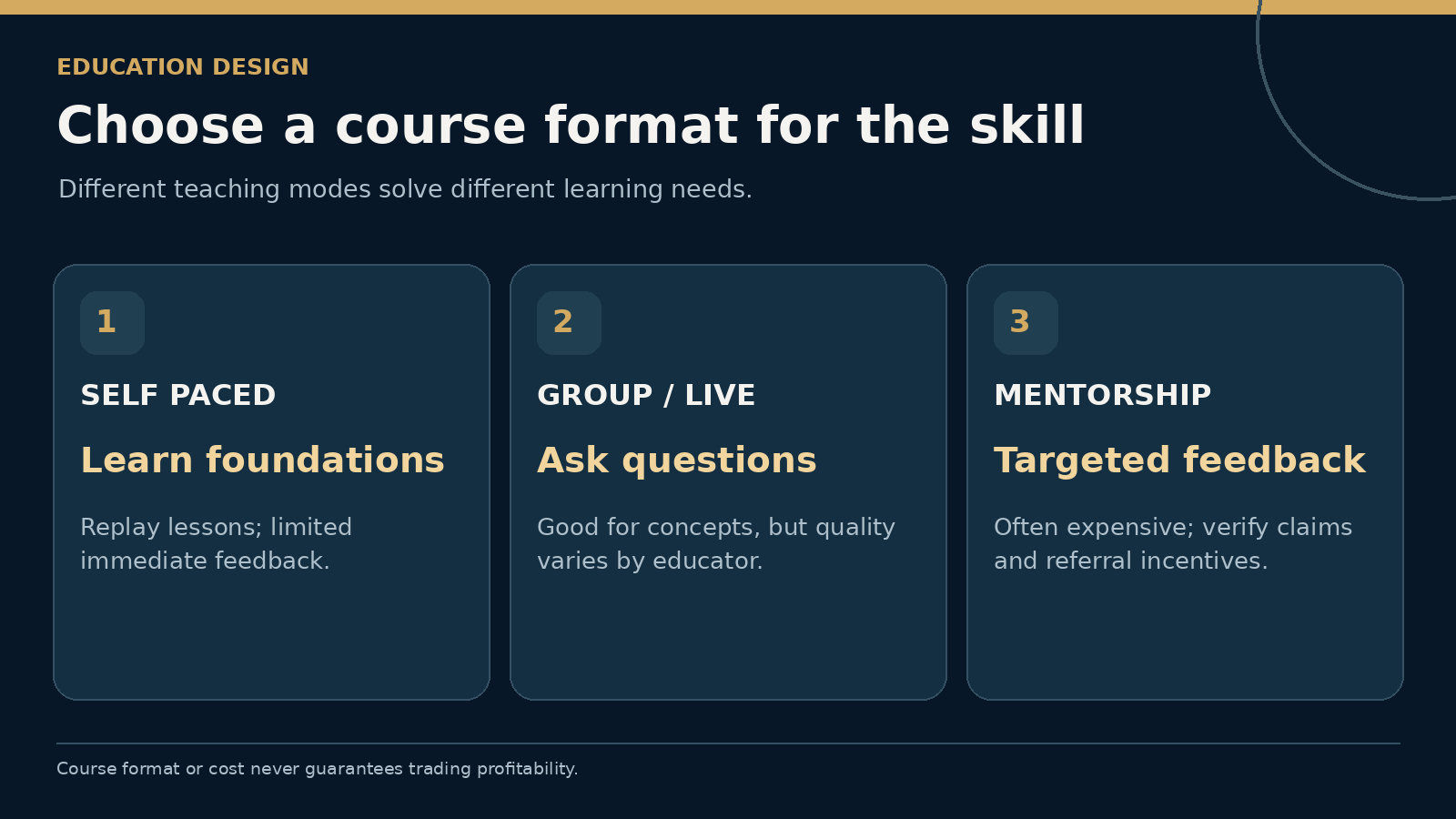
| Format | Useful for | Typical limitation |
|---|---|---|
| Self-paced recorded lessons | Flexible foundational study | Little live feedback |
| Live group webinar | Questions and discussion | Time zone and limited depth |
| Small-group practice | Review of calculation mistakes | Cost and instructor conflicts |
| Individual mentoring | Specific technical feedback | High expense, hard-to-check claims |
| Official education and regulator materials | Contract and risk definitions | Not a personal trading strategy |
3. Look for a syllabus that teaches actual products
A strong programme identifies the difference between owning physical gold, buying a gold-linked fund and trading a margin derivative. CME’s exchange gold contract information documents standard GC futures at 100 ounces, but a CFD broker can define a lot differently. A course should never teach ‘0.01 gold lot always equals one ounce’ without specifying the provider and contract.
4. Teach execution risk with worked examples
Consider a hypothetical five-ounce CFD with a planned stop $10/oz from entry. Gross price loss would be $50 if the close fills exactly there; if it fills $14/oz away, gross loss becomes $70 before fees. Students should be able to explain the discrepancy and account for spreads, financing and maintenance margin. These concepts matter more than memorising a candle pattern.
5. Evaluate the educator, not just the testimonials
A claimed win rate or a five-star review may be selective. Ask whether the instructor has an identifiable legal name, a complete curriculum, verifiable credentials and transparent financial interests. Are affiliate commissions paid for accounts opened through a broker referral? Is the course marketing an automated strategy or expensive follow-on subscriptions? No certificate or private chat group guarantees skill or return.
6. Red flags in trading education
- Guaranteed weekly or monthly trading income or a promise of a high win rate.
- Pressure to pay immediately, deposit through a referral or share broker credentials.
- Screenshots of winning positions without failed examples or complete records.
- An instructor who discourages questioning or independent data verification.
- A course that conceals contract specifications, loss examples or total fees.
The CFTC’s forex fraud warnings discuss how online signals, unfamiliar platforms and software may be promoted using exaggerated results. For Singapore learners, checking entity claims against MAS official records is prudent when a course also sells financial services.
7. A practical course scoring rubric
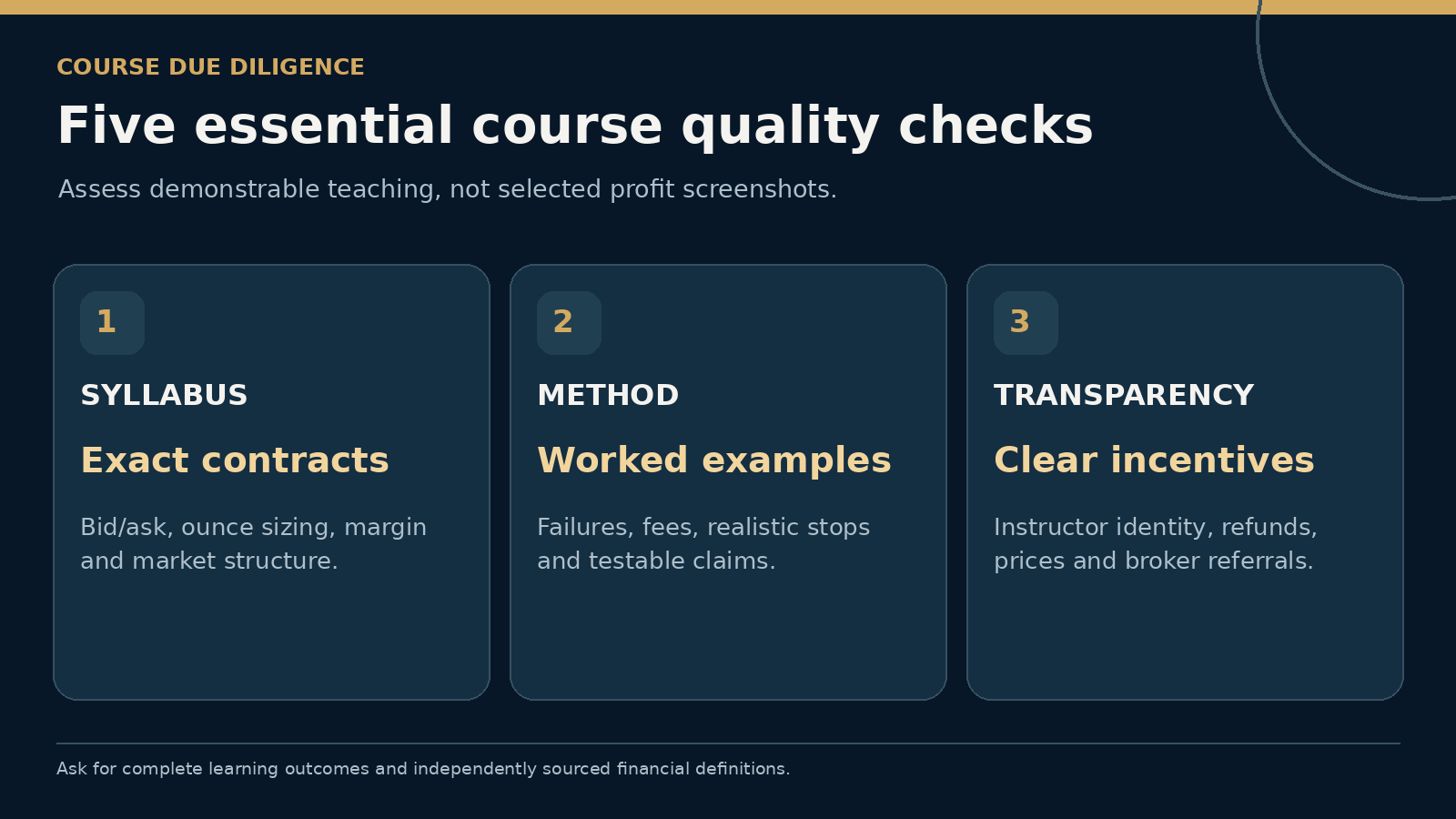
| Area | What good evidence looks like |
|---|---|
| Accuracy | Official sources, dates and product definitions |
| Teaching | Worked examples and access to questions |
| Risk literacy | Stops, leverage, costs and counterparty |
| Testing | Full outcomes, not hand-picked winners |
| Transparency | Instructor, fees, disclosures and refund terms |
8. A sample four-week learning plan
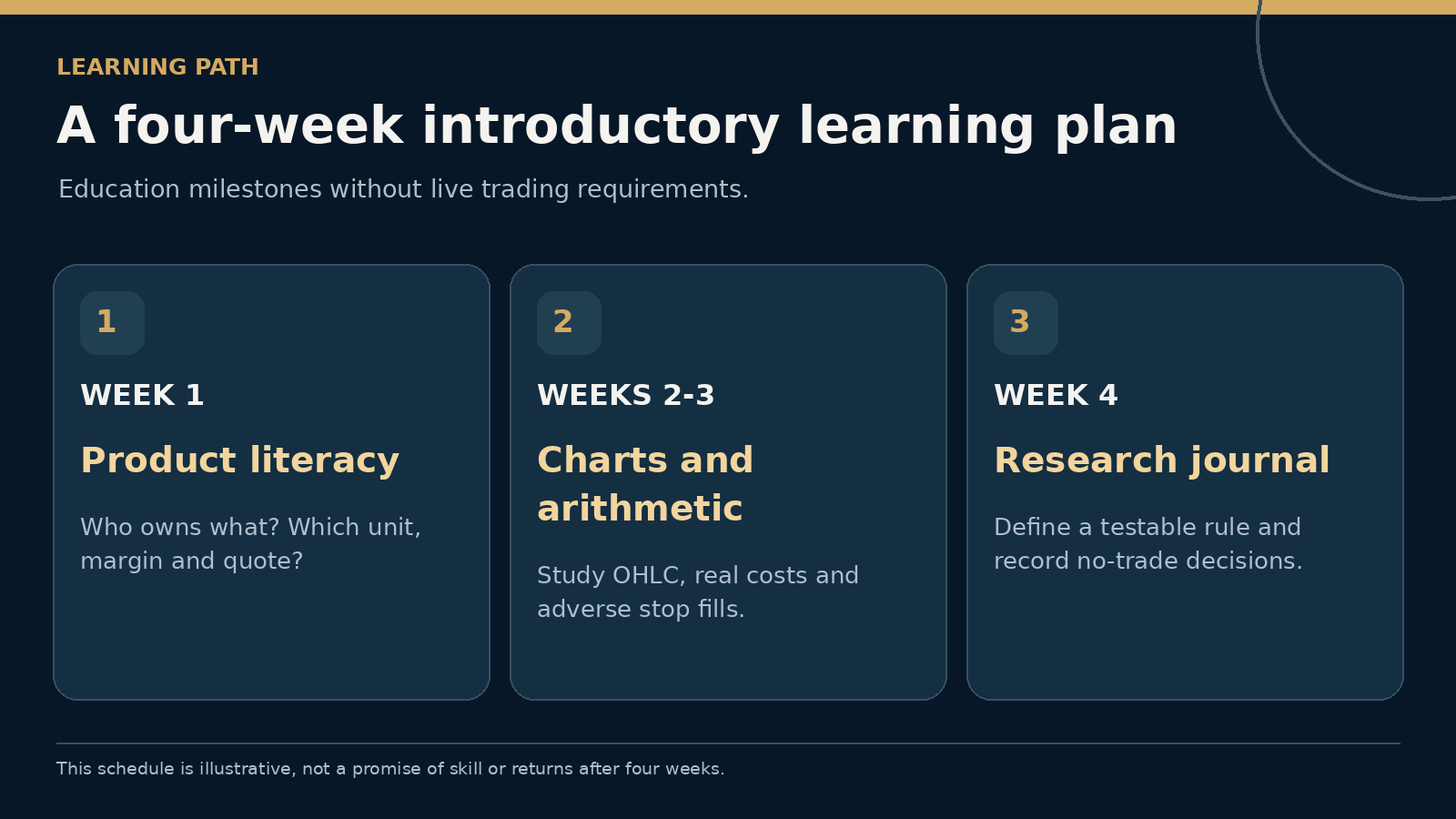
- Week 1: read contract terms, define troy ounces and distinguish bid from ask.
- Week 2: interpret OHLC charts and locate an official economic release.
- Week 3: calculate notional exposure, spread and worse stop fill using fictional numbers.
- Week 4: write a simple testable hypothesis and record reasons to remain flat.
Frequently asked questions
- Must a good gold course be expensive? No; official free resources can teach crucial concepts.
- Do successful traders always make good instructors? No; clear teaching and evidence should be assessed separately.
- Does a certificate establish profitability? No.
- Should I open a live account to complete training? Not necessarily; simulations can teach operational basics.
Key takeaway
The best course for a reader is the one that teaches verifiable financial literacy within a transparent price and risk framework. Evaluate the syllabus and the instructor’s incentives rather than advertised profit stories.
Continue learning
Authoritative references
Educational material only. All quote examples are hypothetical, not current gold prices, realised returns or personalised advice. Trading derivatives may cause substantial losses.