

The best-looking gold trading screen is not necessarily the most suitable way to access gold. A charting application displays market data, while a broker or fund platform holds the legal customer relationship and executes instructions. A beginner should evaluate the product, the legal counterparty, total costs, order handling and security before treating any interface as safe or inexpensive.
1. Separate charting software from the broker
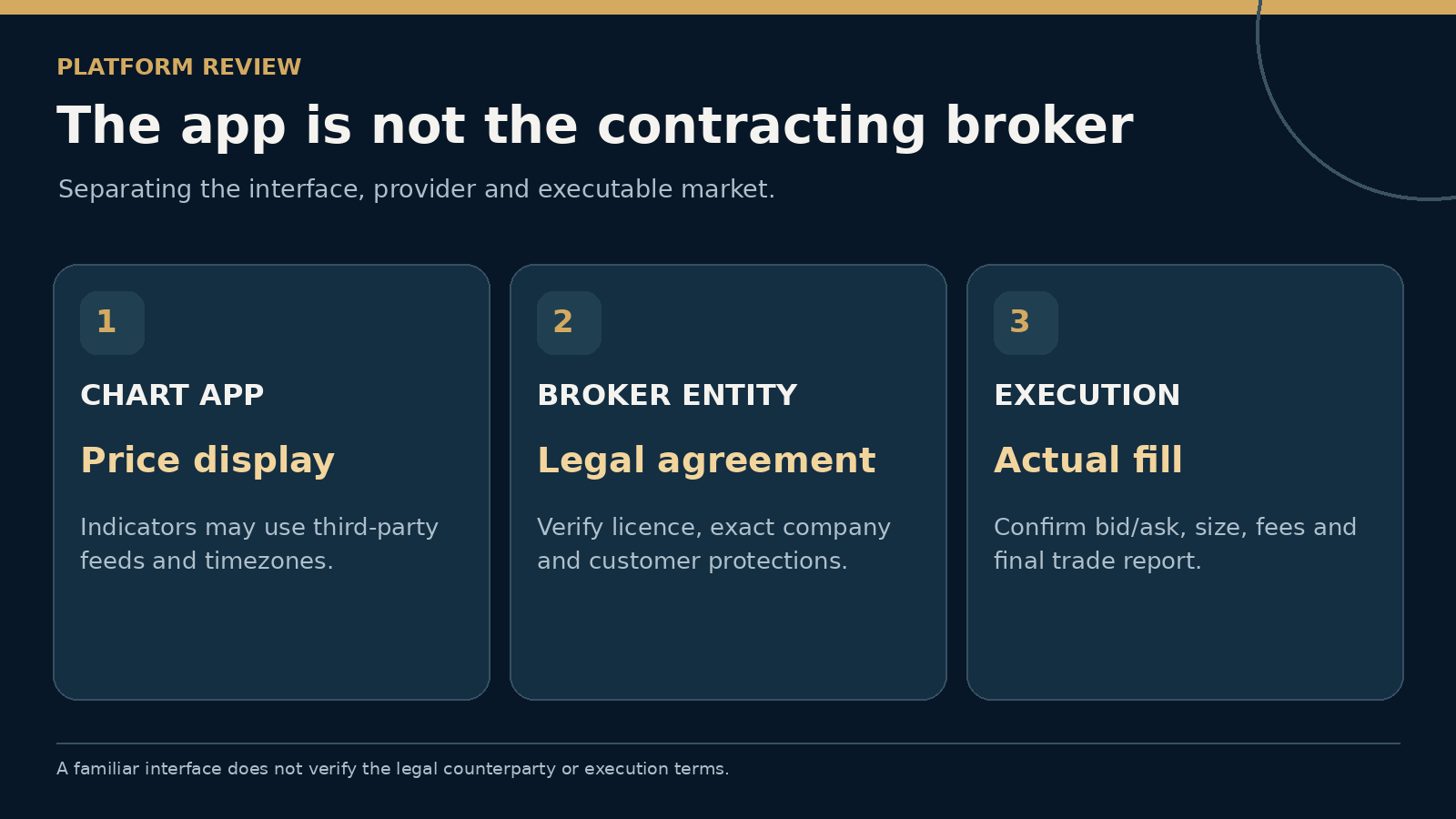
An analytical application may show candlesticks, alerts, RSI and moving averages while displaying a feed different from the prices offered by a particular broker. A trading terminal may route orders to a broker or liquidity provider, but the terminal’s brand is not the same as the contracting entity. Do not assume a quoted ‘gold price’ on one chart is exactly executable in another account.
2. Verify the exact legal entity and jurisdiction
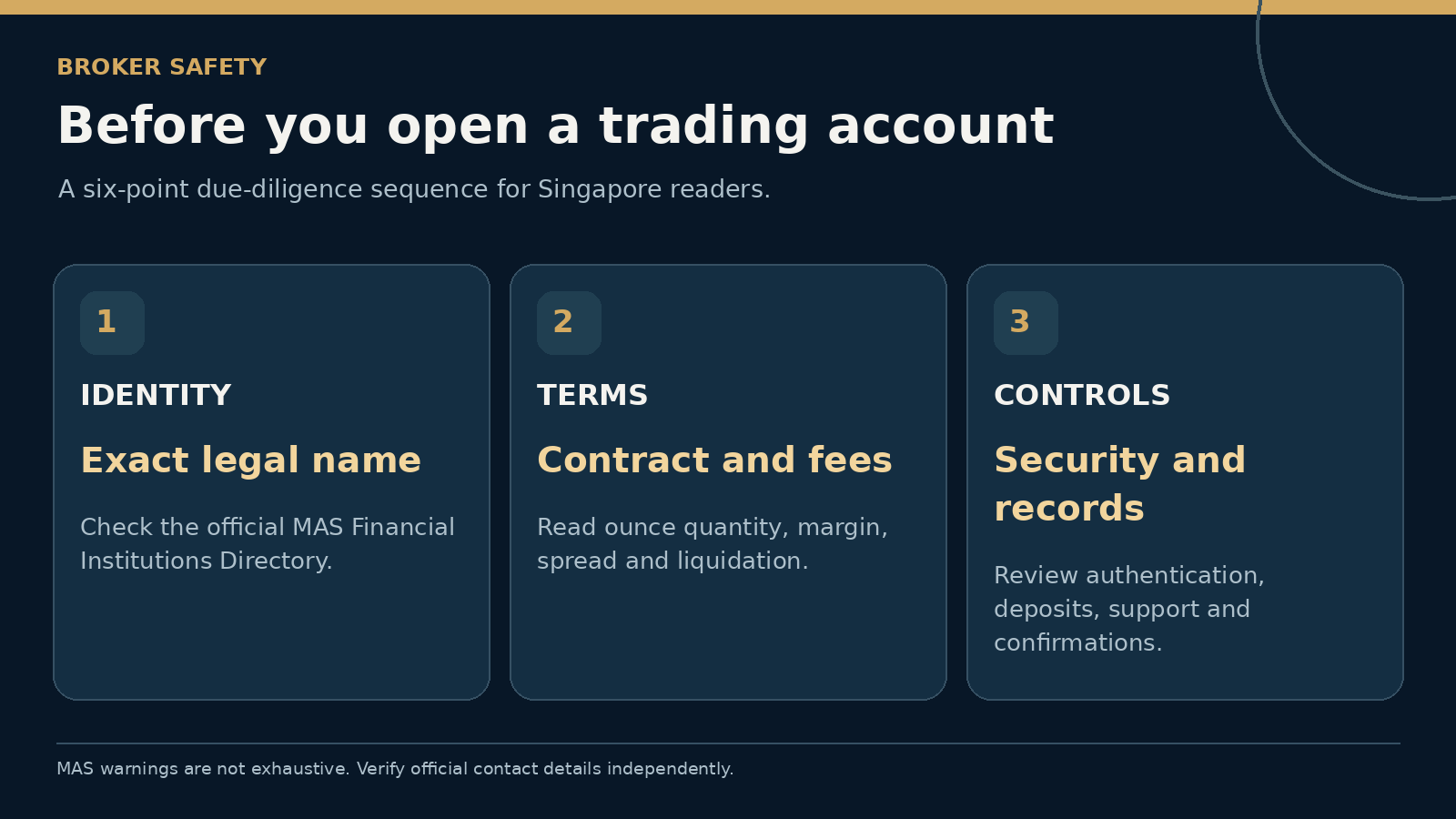
For Singapore clients, consult the MAS Financial Institutions Directory to inspect a firm’s exact legal identity and relevant activities; the MAS Investor Alert List also provides warnings but is not exhaustive. A website may impersonate a licensed firm. Use official contact details, not phone numbers in unsolicited messages. Overseas registration and regulation may apply to a different group subsidiary or product.
3. Choose the gold product before comparing apps
| Product | Contract or asset | What platform must explain |
|---|---|---|
| Bullion | Physical metal | Custody, delivery, dealer spread |
| Gold ETF/fund | Securities or fund units | Trading venue, ongoing fees |
| Listed gold futures | Exchange-defined derivative | Contract size, expiry, margin |
| Gold CFD | OTC contract with provider | Bid/ask, lot ounces, financing, close-out |
CME standard GC futures represent 100 ounces, Micro Gold 10 ounces and the separate 1OZ product one ounce. A retail CFD provider’s lot definition is not fixed by those exchange standards. A platform that displays 0.01 lots may still create an unexpectedly large ounce exposure.
4. Calculate a total dealing cost, not a ‘zero fee’ claim
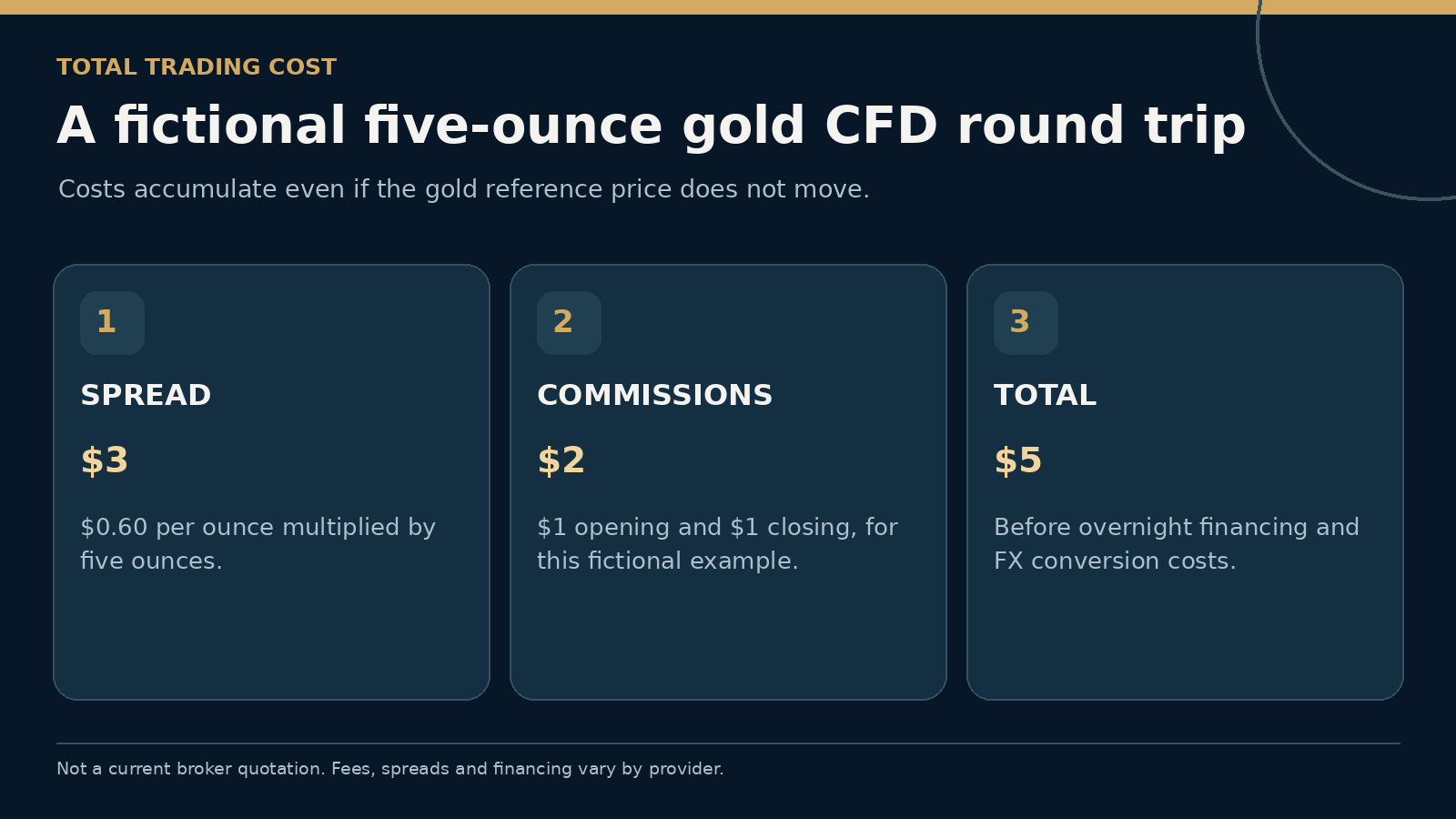
Imagine a hypothetical XAU/USD CFD with bid $1,999.70 and ask $2,000.30. A five-ounce immediate round trip at unchanged quotes has a $3 spread cost. If the hypothetical provider also charges $1 on opening and $1 on closing, total spread-plus-commission cost is $5 before overnight financing or conversion. ‘Commission free’ might simply mean that a larger spread contains much of the cost.
| Hypothetical trading charge | Five-ounce illustration |
|---|---|
| Spread $0.60/oz | $3 |
| Open commission | $1 |
| Close commission | $1 |
| Total before any financing/FX | $5 |
5. Compare order handling, not just button speed
A market order prioritises execution and may fill at a worse price; a limit can remain unfilled; a stop trigger is not a guaranteed loss ceiling. If a five-ounce long has a stop $10/oz from entry, gross loss at that exact exit would be $50. An adverse fill $14/oz from entry creates $70 loss before charges. The MoneySense CFD guide describes additional margin and counterparty risks.
6. Examine account security and operational resilience
Check multi-factor authentication, secure recovery procedures, client-asset handling disclosures, current margin-closeout policies and how disputes are addressed. Avoid treating ‘segregated funds’ or ‘negative balance protection’ as universal: protections depend on the exact entity, contract, rules and jurisdiction. Ask whether the account is able to provide downloadable confirmations and whether support is available when a critical error occurs.
7. Evaluate demo environments realistically
Simulation can teach order entry, contract sizes and a trading journal, but may not reflect live spreads, liquidity, slippage or interruptions. A demo win streak does not verify a profitable trading strategy. Check whether the demo and live accounts use identical symbols, dealing hours and quantity units, and whether those terms are subject to change.
A transparent platform evaluation scorecard
| Check | Evidence to obtain |
|---|---|
| Legal identity | Regulator directory and matched official domain |
| Product | Contract document and ounce minimum |
| Costs | Spread, commission, financing and FX example |
| Execution | Order types, slippage and outages |
| Safety | Security, funds treatment and dispute channel |
| Learning | Demo operations without forced deposit |
Frequently asked questions
- Is a popular charting app the same as a regulated broker? No.
- Is a 0.5-pip gold spread universal? No; broker point definitions and quotes differ.
- Does regulation guarantee a profitable account? No.
- Are all gold products tradeable 24 hours? No; schedules differ.
Key takeaway
A credible gold-platform comparison is a set of independently verifiable facts about the contracting company and the product. Avoid ranking a provider solely on marketing, screenshots or an app’s interface.
Continue learning
Authoritative references
- MAS — Financial Institutions Directory
- MAS — Investor Alert List
- MoneySense — Understanding CFDs
- CME — Gold Futures
Educational only: all calculations are fictional and not current gold quotes, verified historical returns or personal financial advice. Derivatives may lead to substantial loss.