

Leverage allows a gold trader to obtain price exposure larger than the initial margin deposited. It is not free capital or a guarantee of better returns. The most important calculation is how many ounces of gold a position represents, because that—not the leverage ratio by itself—determines the gross dollar effect of a price change.
1. What leverage actually changes
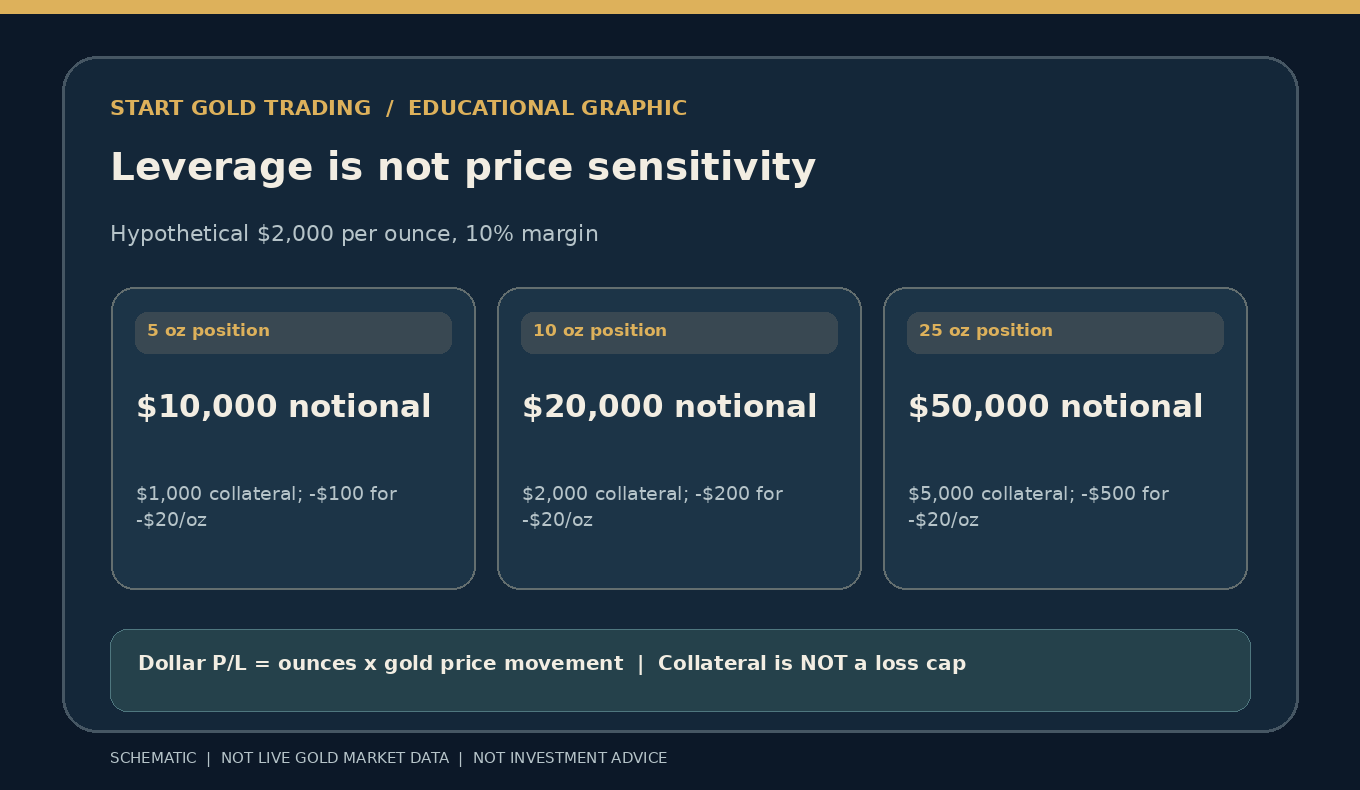
Imagine a hypothetical gold price of $2,000 per troy ounce. A ten-ounce long CFD creates approximately $20,000 notional exposure. If the provider requires 10% initial margin, $2,000 may be needed as collateral. A $20-per-ounce adverse price movement creates a $200 gross loss; a $20-per-ounce favourable move creates a $200 gross gain. The margin arrangement changes how much collateral is tied up, not the ten-ounce price sensitivity.
| Position | Notional exposure | Margin at 10% | Gross P/L for −$20/oz |
|---|---|---|---|
| 5 oz long | $10,000 | $1,000 | −$100 |
| 10 oz long | $20,000 | $2,000 | −$200 |
| 25 oz long | $50,000 | $5,000 | −$500 |
The original article’s table treated a $10 gold move as an automatic $100, $500 or $1,000 profit or loss for different leverage labels. That is incomplete: the result requires the quantity of ounces and actual executable price. The table above holds those assumptions explicit.
2. Know the difference between margin and capital at risk
Initial margin is a provider’s collateral requirement, not a contractual limit on loss. Maintenance margin may change and an open position may be liquidated if the account no longer meets it. An OTC CFD does not convey ownership of gold and also exposes a customer to the CFD provider. Singapore MoneySense outlines collateral, liquidation, financing and counterparty risks.
3. A hypothetical stop that fills worse than planned
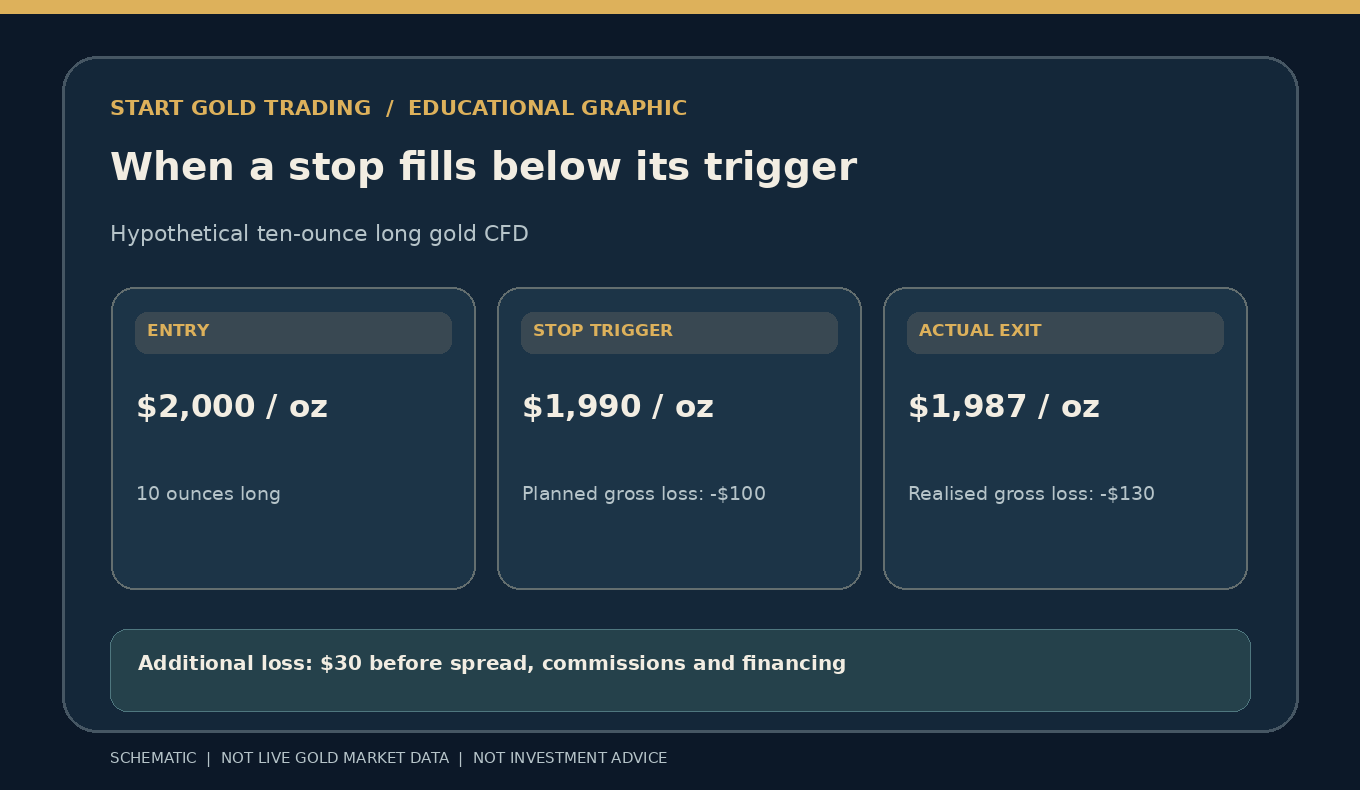
Suppose the ten-ounce long enters at $2,000/oz and the planned stop is triggered at $1,990. That represents a $100 planned gross loss. If the broker fills the close at $1,987, the gross price loss is $130 before spread, commissions and financing. Choosing a smaller size or an automatic stop does not remove the possibility of slippage, gaps, rejected orders or a forced margin close-out.
4. Understand account equity and combined positions
Exposure should include every open position and pending order. If two separate ten-ounce long orders both fill, their combined sensitivity is $20 of P/L for each $1/oz gold movement, before fees. Opening several positions under different strategy names does not diversify their directional exposure. Reconcile the trading interface to the provider’s confirmed positions.
5. Compare the instruments before selecting leverage
Standard CME Gold futures have 100 troy ounces per GC contract, while smaller listed contracts and retail CFDs follow different specifications. A CFD account’s 0.01 lot is not universally one ounce, and exchange margin and settlement mechanisms differ from OTC dealing. Check CME Group’s live contract descriptions before using an exchange example to size a broker CFD.
6. A reusable leverage-check sequence
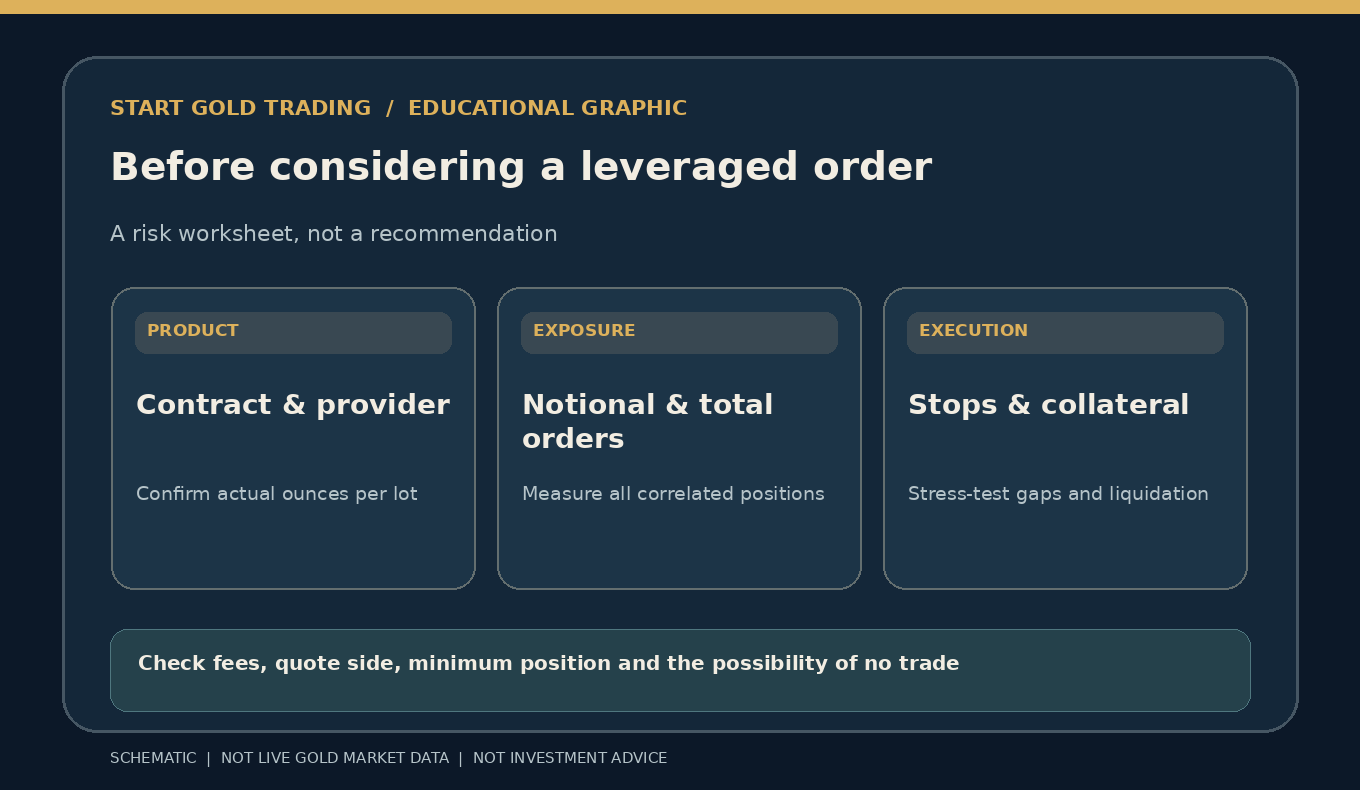
- Find the legal counterparty and instrument contract specification.
- Convert proposed lots or contracts into the actual ounce equivalent.
- Multiply ounces by the quoted price to estimate notional exposure.
- Estimate margin and continuing collateral obligations.
- Calculate dollar P/L for both a small and severe adverse move.
- Model a worse-than-planned stop fill and all costs.
- Decide whether the minimum permitted position fits the available resources; staying flat may be appropriate.
Frequently asked questions
- Does 1:10 leverage mean I lose 10% on a $1 move? No. The dollar result depends on ounces and the reference price.
- Is low leverage automatically safe? No. Gold itself is volatile and product/counterparty risk remains.
- Can losses exceed initial margin? Yes, depending on the contract and applicable safeguards.
- Will a stop close exactly at my chosen price? Not necessarily; execution can be worse.
Key takeaway
Leverage is best understood as a relationship between notional exposure and collateral. Begin with ounces and realistic execution outcomes rather than a leverage-number slogan.
Explore related gold education
Primary sources
For education only. All price examples are hypothetical and do not describe current market quotes or promised returns. Gold derivatives and leveraged products involve significant loss risk. This is not personalised investment advice.