

Searches for the ‘best gold trading broker’ often return a ranked list of company names with impressive badges and deposits as low as a few dollars. A ranking does not establish which legal entity would service a particular customer’s account, what product would be traded, or whether the risk is affordable. This guide offers seven repeatable checks. Its purpose is to help you evaluate a broker, not to endorse one or encourage an account opening.
Check 1: Identify the exact provider and regulatory permission
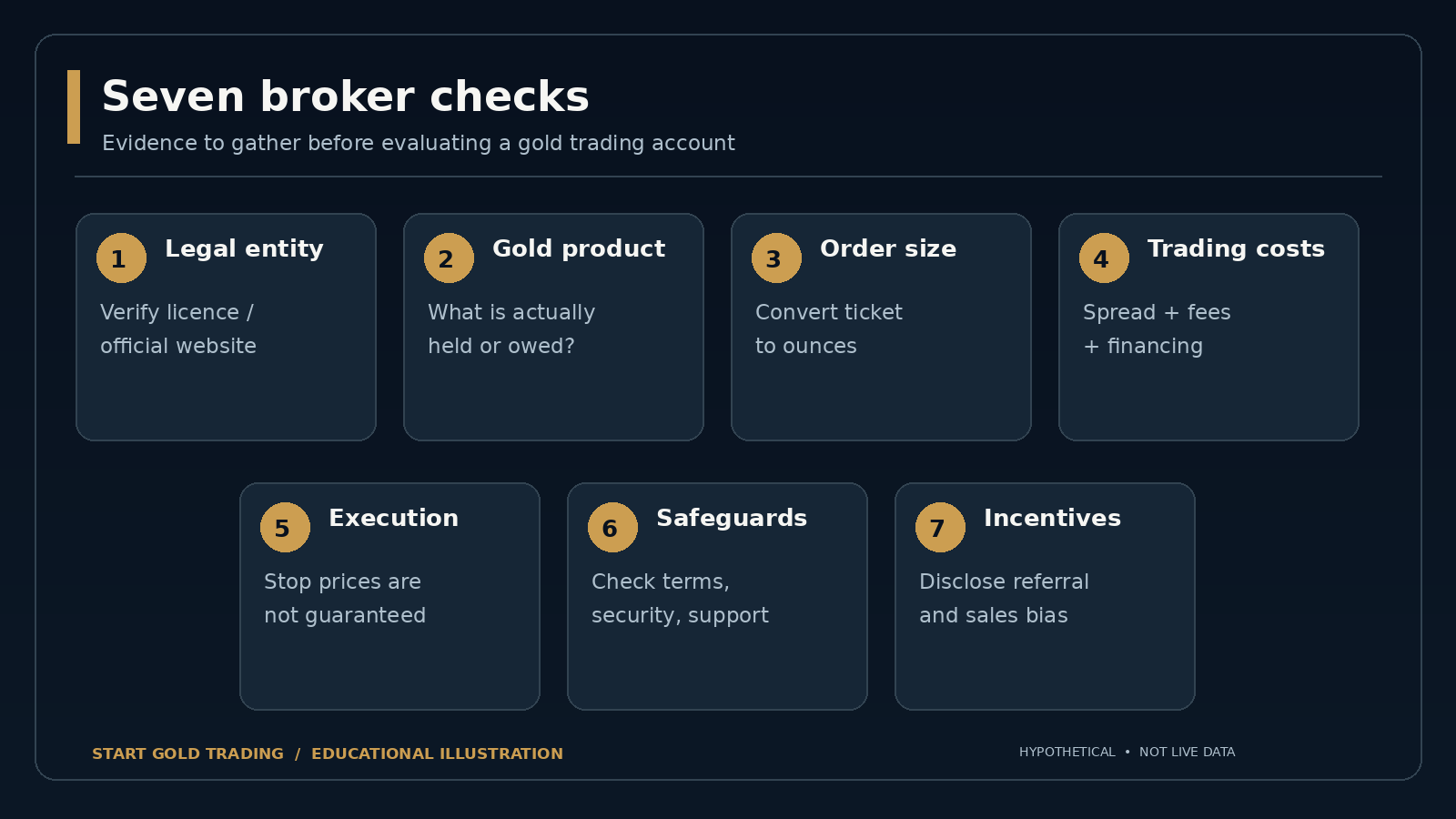
A familiar brand may operate through different subsidiaries in different countries. The licensing, legal safeguards and products associated with one subsidiary must not be attributed to every other entity using the same brand. In Singapore, search the MAS Financial Institutions Directory for the exact company name and the relevant activity; compare independently sourced contact details with the proposed website. The MAS Investor Alert List is useful context but is expressly not exhaustive. A scammer may impersonate a legitimate firm.
Check 2: Understand the gold product before selecting software
A platform may offer physical bullion, fund units, gold futures or an OTC XAU/USD CFD. These differ in ownership, trading hours, fees and legal protections. A CFD buyer does not own bullion and depends on the provider’s contractual obligations. By contrast, a listed futures contract has exchange-defined specifications and clearing arrangements. Selecting a brand based on its app’s charts does not answer which instrument is involved.
| Product | What the customer holds | Question to verify |
|---|---|---|
| Bullion | Gold with defined storage or possession arrangement | Custody and resale conditions |
| Gold-linked fund | Fund or security units | Expenses, tracking and custody |
| Exchange future | Listed derivative contract | Lot size, expiry, margin and venue |
| Gold CFD | Provider-specific bilateral contract | Counterparty, spread, financing and leverage |
Check 3: Convert the ticket into ounces and notional exposure
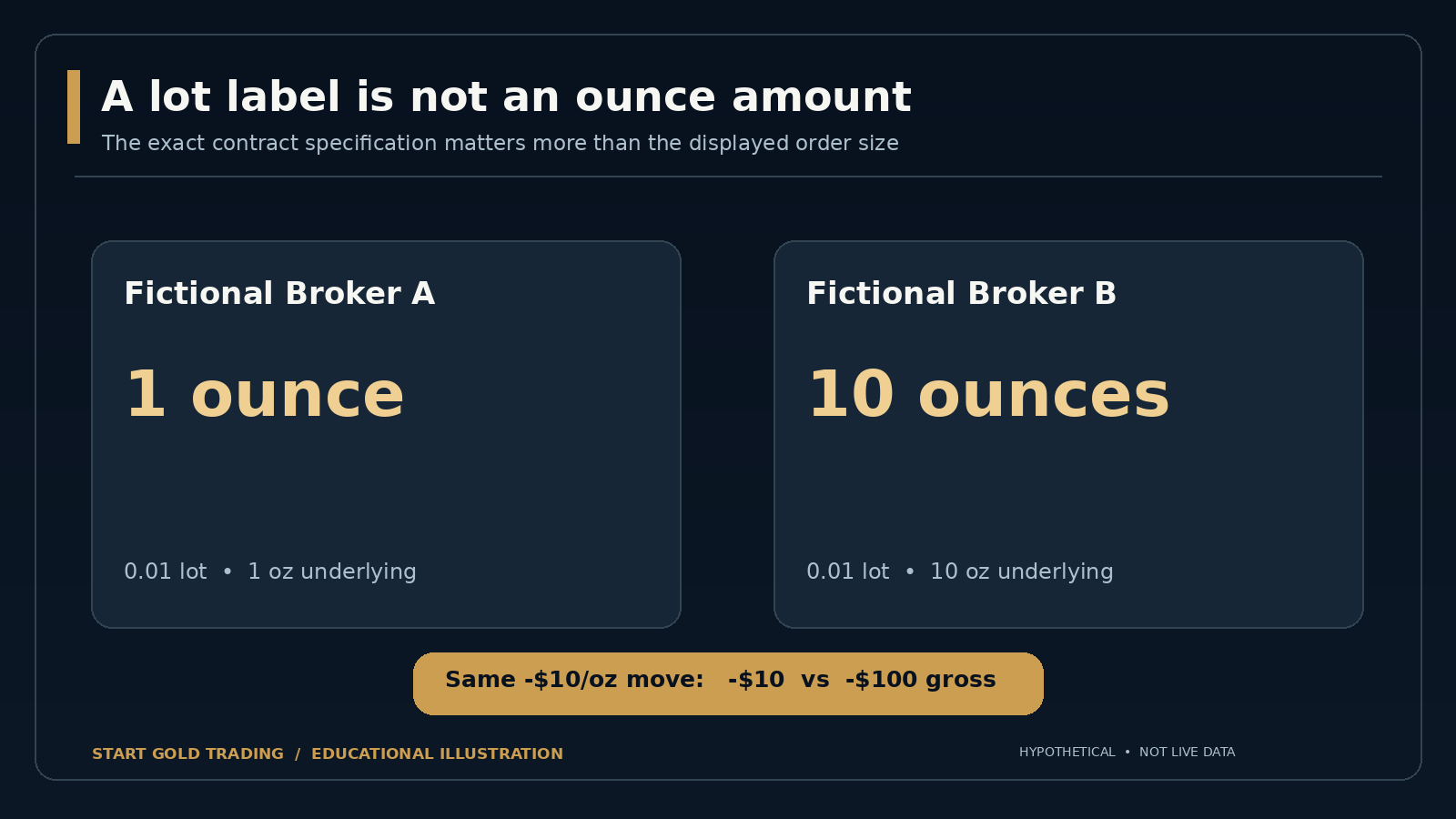
CME lists standard Gold futures (GC) at 100 troy ounces, Micro Gold (MGC) at 10 ounces and a separate 1-Ounce Gold (1OZ) product. A retail CFD’s lot definition can differ among firms. In a fictional example, Broker A treats 0.01 lot as one ounce while Broker B treats 0.01 lot as ten ounces. A $10/oz adverse movement means a $10 gross loss in the first case and $100 in the second before fees. That tenfold difference matters far more than a small minimum deposit.
Check 4: Compare the full economics of a position
The spread is the ask minus the bid, and a brokerage may also charge opening and closing commissions, overnight financing, currency conversion or account-related fees. A broker advertising ‘zero commission’ may recover revenue through its quotes. Demand the current symbol specification and a complete fee schedule for the exact entity and account type. The companion guide to comparing gold trading costs explains how to compare two fictional pricing structures on a consistent ounce basis.
Check 5: Treat orders as instructions, not guaranteed fills
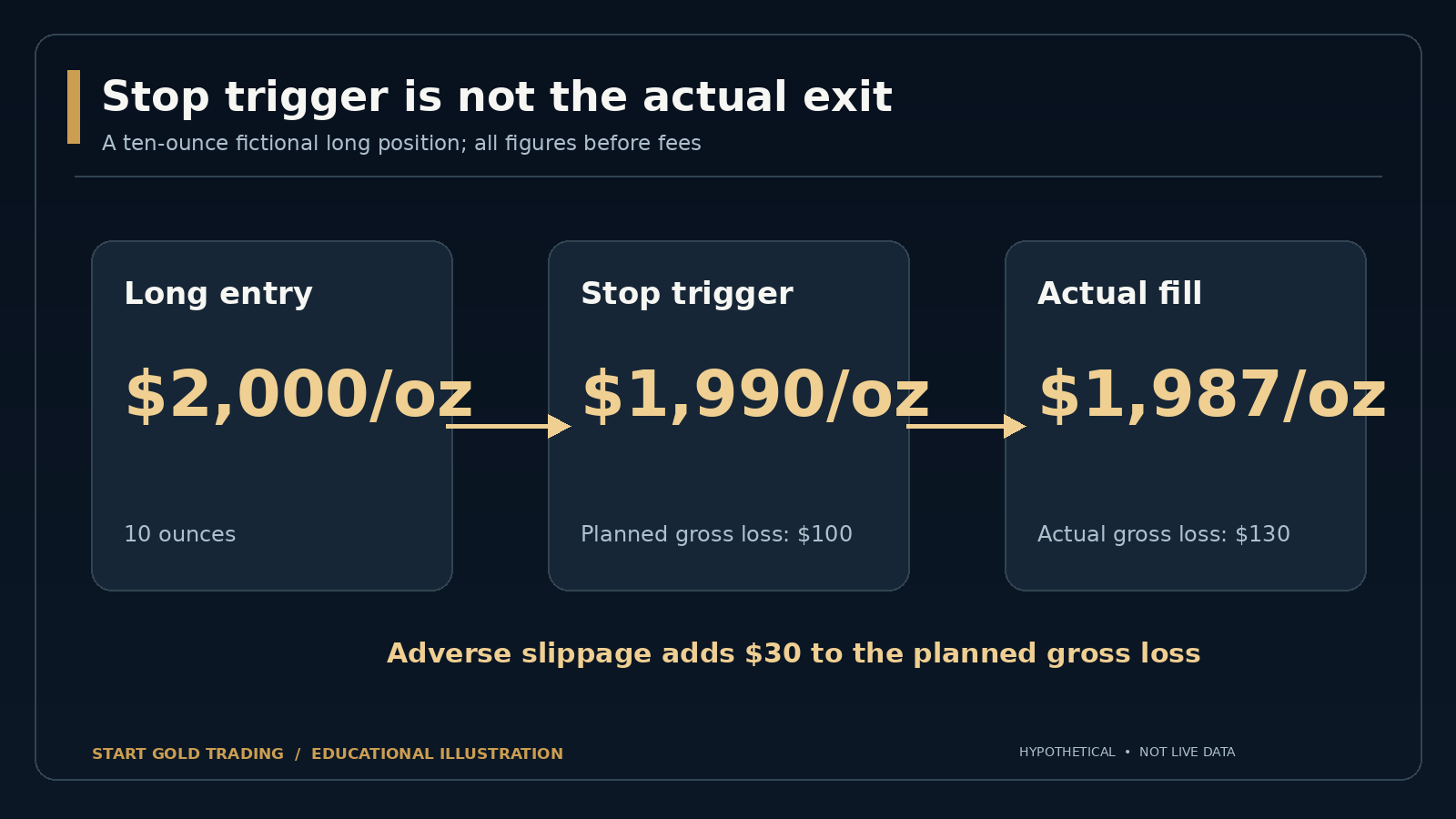
A market order may execute at a different price from the chart when the market moves quickly. An ordinary stop may become a market order once triggered; a stop-limit can remain unfilled. For a hypothetical ten-ounce long entered at $2,000/oz, a stop trigger at $1,990 suggests $100 gross planned loss if filled there. A worse fill at $1,987 produces $130 gross loss before costs. The MoneySense CFD education guide and Investor.gov’s updated stop-order bulletin explain why an exit trigger is not a contractual loss cap.
Check 6: Examine account safeguards and operational failure modes
Ask whether multi-factor authentication is available, how customer funds are handled, how margin calls and forced liquidations work, which support channels operate at relevant trading hours, and whether the platform provides downloadable confirmations. Account security controls, fund segregation and negative balance protection cannot be assumed to apply identically to every institution, customer class or jurisdiction. Read the provider’s actual terms. Even a properly licensed provider cannot remove market losses.
Check 7: Review incentives, marketing and credible evidence
Affiliate payments can affect rankings. A paid placement or referral commission should be disclosed, and a comparison should identify when spreads or availability were measured. Testimonials, selective winning screenshots and copy-trading claims do not establish verified returns. Be especially cautious of promises of guaranteed monthly profits, pressure to deposit, unsolicited login requests or instructions to use an unfamiliar website that imitates a licensed business.
A seven-check evidence worksheet
| Check | Evidence to retain | Reason to pause |
|---|---|---|
| Legal entity | Directory record and official domain | Names or addresses mismatch |
| Actual product | Contract description and rights | It is unclear what is held |
| Exposure | Ounces per order unit | Position size cannot be verified |
| All-in fees | Current charges for the relevant account | Costs cannot be reproduced |
| Execution | Stop/limit and margin terms | Losses are described as guaranteed-capped |
| Operational safety | Security, statements, support | No reliable dispute or recovery route |
| Incentives | Referral disclosures and records | Pressure, secrecy or unsupported results |
How to use a demo account responsibly
Simulation can help you practise order entry, cancelling instructions, changing quantities and reconciling transactions without committing money. However, demo fills, spreads and emotional demands may differ from live trading. A winning demo period does not verify strategy profitability. Use a demo to test whether you understand the interface, not as proof that a broker is safe or a strategy will earn money.
Frequently asked questions
- Which gold broker is safest? There is no universal ranking; assess the exact entity, product and local protections.
- Is a licensed broker risk-free? No. Product and market losses remain possible.
- Does a $100 minimum deposit make trading affordable? No; actual exposure and fees must be calculated.
- Is copy trading a substitute for due diligence? No. Someone else’s result does not define your execution or risk.
- Are all gold platforms open 24/5? No. Trading schedules vary by instrument and venue.
Key takeaway
The useful answer to ‘which gold broker is best?’ starts with seven pieces of verifiable evidence. A broker might pass an identity check and still offer a product unsuitable for your resources or purposes. Walking away is a valid outcome.
Related gold education
- Gold Trading Resources
- Choosing a Gold Trading Platform
- Beginner Gold Trading Guide
- Original related resource
Official references
- MAS — Financial Institutions Directory
- MAS — Investor Alert List
- MoneySense — Understanding Contracts for Difference
- CME — Gold Futures Product Specifications
- Investor.gov — Stop Orders and Execution
Education only. Company comparison labels and all dollar amounts in worked examples are fictional; not current broker quotes, guaranteed returns or personal financial advice. Gold derivatives carry substantial loss risk.