

Swing trading gold involves holding price exposure across several sessions—often days or weeks—to study a potential move rather than every short-lived fluctuation. It usually requires fewer entry decisions than day trading but introduces overnight and weekend gap risk, financing costs and more prolonged margin exposure. It is not automatically easier or safer for a beginner.
What instrument is being held?
An OTC XAU/USD CFD contract is different from an exchange-listed future or a gold-backed fund. It may charge overnight financing and may be liquidated by a provider if margin is insufficient. Futures have contract sizes, expiry and settlement rules; CME’s standard GC contract represents 100 ounces. Read the MoneySense risk explanation and CME contract details rather than assuming all gold products behave alike.
A checked reward-to-risk illustration
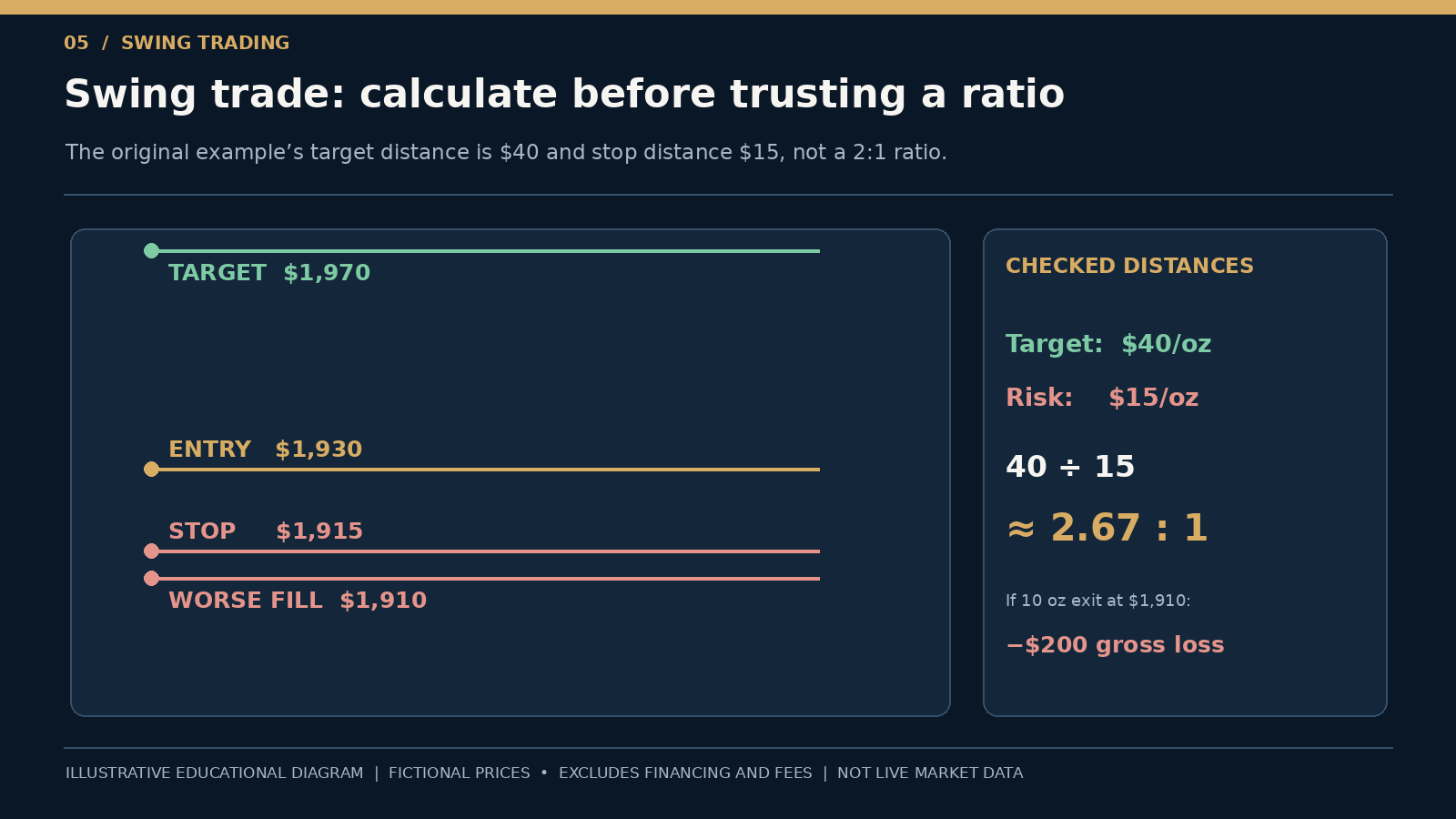
The prior article described a hypothetical long entry at $1,930, stop trigger at $1,915 and target at $1,970 as ‘1:2’. Those figures actually imply $15 per ounce planned downside and $40 per ounce target distance. The price-distance ratio is $40 / $15 ≈ 2.67:1, not 2:1. This does not imply a 2.67 expected return or a profitable strategy.
| Hypothetical field | Value |
|---|---|
| Entry / stop / target | $1,930 / $1,915 / $1,970 per ounce |
| Downside to trigger | $15 per ounce |
| Distance to target | $40 per ounce |
| Target distance / downside | 40/15 = 2.67:1 |
| Example 10 oz exposure at trigger | Gross planned loss $150 |
| Example 10 oz exposure at target | Gross gain $400, before costs |
What if the stop slips after an overnight gap?
For that illustrative ten-ounce long, a worse-than-trigger exit at $1,910 per ounce would produce a $200 gross loss rather than the $150 calculated at the stop level. If, separately, a fictional provider charged $3 per night for four nights, holding finance would total $12 before other costs. These numbers do not describe a real broker quote.
Why account size alone cannot determine lot size
A universal table recommending 0.01 lots for a $100 account is unsound because different products define contract units differently. Start with a chosen planned-risk budget, divide by the entry-to-invalidation distance per ounce, check the product’s tradable minimum, then stress-test slippage. If the available minimum is too large, remaining flat may be the only way to meet the budget.
A clear swing-trading research framework
- Specify price series, instrument, holding horizon and allowed exposure.
- Define an observable setup and invalidation condition before seeing subsequent price bars.
- Check macroeconomic event dates, financing and weekend/dealing breaks.
- Measure both planned and actual order fills, including gaps and spread changes.
- Test signals over multiple volatility regimes without selecting only attractive winners.
- Review cumulative exposure and account capacity to maintain margin.
Timeframes and indicators are not guaranteed advantages
A 4-hour or daily chart may reduce the number of decisions needed, but cannot make historical patterns reliably predictive. Moving averages, RSI, Fibonacci levels and candle shapes are different descriptions of past prices. More overlays can appear to confirm one another because they reuse the same underlying data.
Key takeaway
Swing trades need a well-defined holding-risk plan. Correct ratio arithmetic helps explain an example but does not establish profitability, and overnight execution can increase losses beyond a planned stop.
Continue learning
References
- MoneySense — Understanding Contracts for Difference
- CME — Gold Futures Specifications
- CME — Technical Analysis
Educational information only. All numerical examples are hypothetical, not historical or current quotes. Neither trading strategies nor stop orders guarantee profit or a fixed loss ceiling. Leveraged products can cause substantial losses.