

New gold traders often spend more time searching for an indicator than learning what their order actually represents. This guide focuses on six practical lessons that help readers ask better questions before risking money. It does not promise that following the lessons will produce profits: a disciplined trader can still lose if prices or execution move unfavourably.
Lesson 1: Gold is not simply another forex pair
Retail platforms often display XAU/USD beside currencies. An OTC gold contract for difference (CFD) normally exposes a customer to a provider’s gold quotation rather than conveying ownership of bullion. Spreads, dealing hours, financing and margin terms can differ from exchange-traded gold futures or gold-backed funds. Check the contract’s ounces per lot, minimum order size and the legal entity before comparing charts.
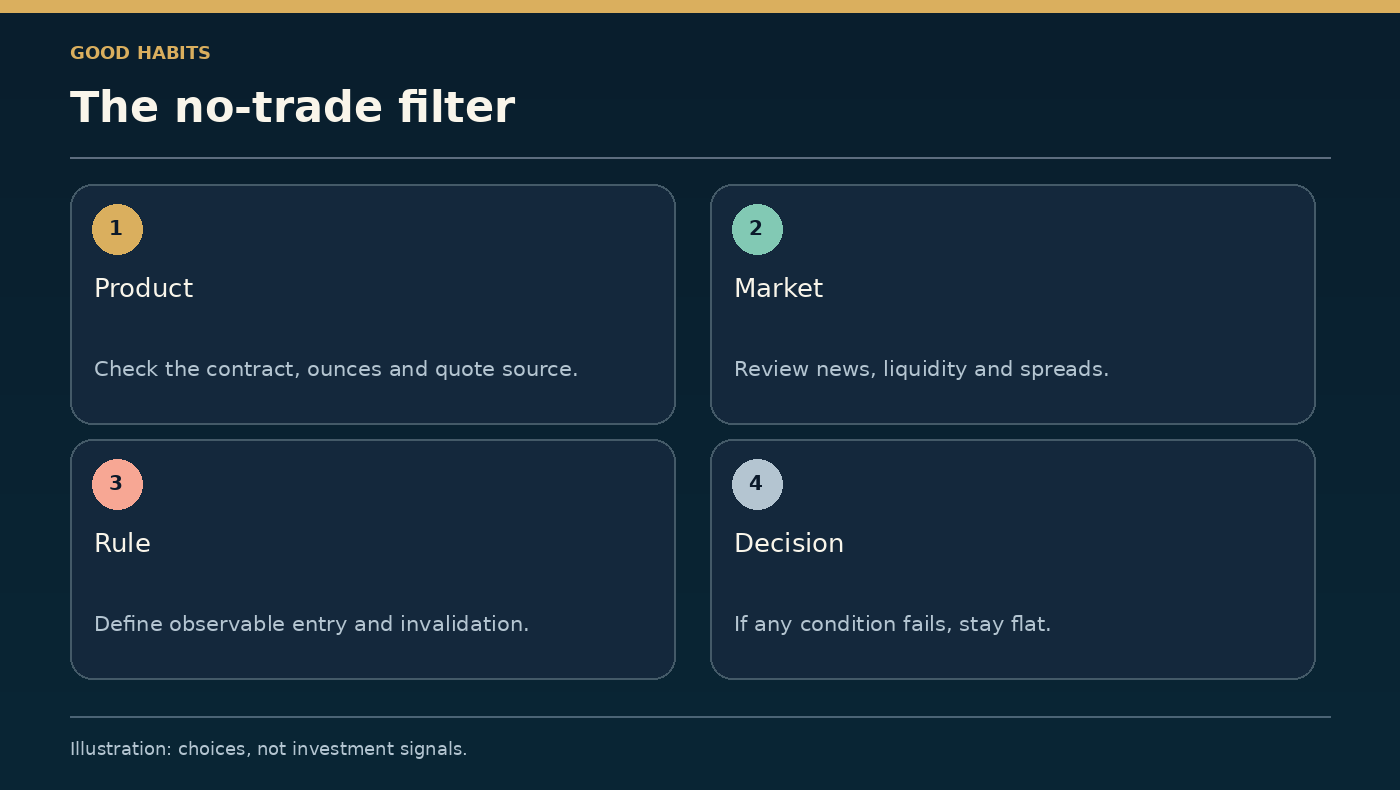
Lesson 2: Learn when doing nothing is the right choice
A missed price movement is not automatically a missed good trade. If the spread is abnormally wide, the setup is absent or the smallest position exceeds a planned loss budget, remaining flat is a deliberate decision. A trader should be able to explain the no-trade rule without looking at what the next candle did.
| Question before an order | Acceptable evidence | Reason to stand aside |
|---|---|---|
| Is the product understood? | Written ounces per lot and dealing terms | Unclear contract or legal counterparty |
| Is there a defined setup? | Prewritten observable trigger | An urge driven by recent price movement |
| Can loss be tolerated? | Exposure and slippage scenario | Minimum order exceeds planned budget |
| Is execution reasonable? | Current bid/ask and provider hours | Unknown spreads or event disruption |
Lesson 3: Macro events are not simple buy or sell instructions
Gold may react to the dollar, real Treasury yields, inflation expectations and demand for liquidity. Geopolitical tension can encourage safe-haven buying, but forced selling or a strong dollar may offset it. Avoid absolute claims such as ‘fear always pushes gold up’. Record the data-release timestamp and what the market had expected before judging the move.
Lesson 4: A simple chart rule needs an honest test
An indicator or support line summarises historical prices; it does not reveal the identity of the next buyer. Instead of saying ‘buy above the moving average’, a research hypothesis could define a completed-bar condition, a fixed holding period and an invalidation rule, and then count every occurrence. Include failed trades, fees, changing spreads and market regimes. CFA Institute explains historical-testing limitations.
Lesson 5: Small lots are only small when the ounces are small
Imagine a hypothetical broker where 1.00 lot equals 100 ounces: 0.01 lot represents one ounce, and a $10-per-ounce price change causes a $10 gross change before fees. At another broker with a different underlying lot specification, the same 0.01 input can create a very different exposure. Margin collateral does not limit losses, and a stop trigger is not a guaranteed closing price. See MoneySense’s CFD risk guidance.
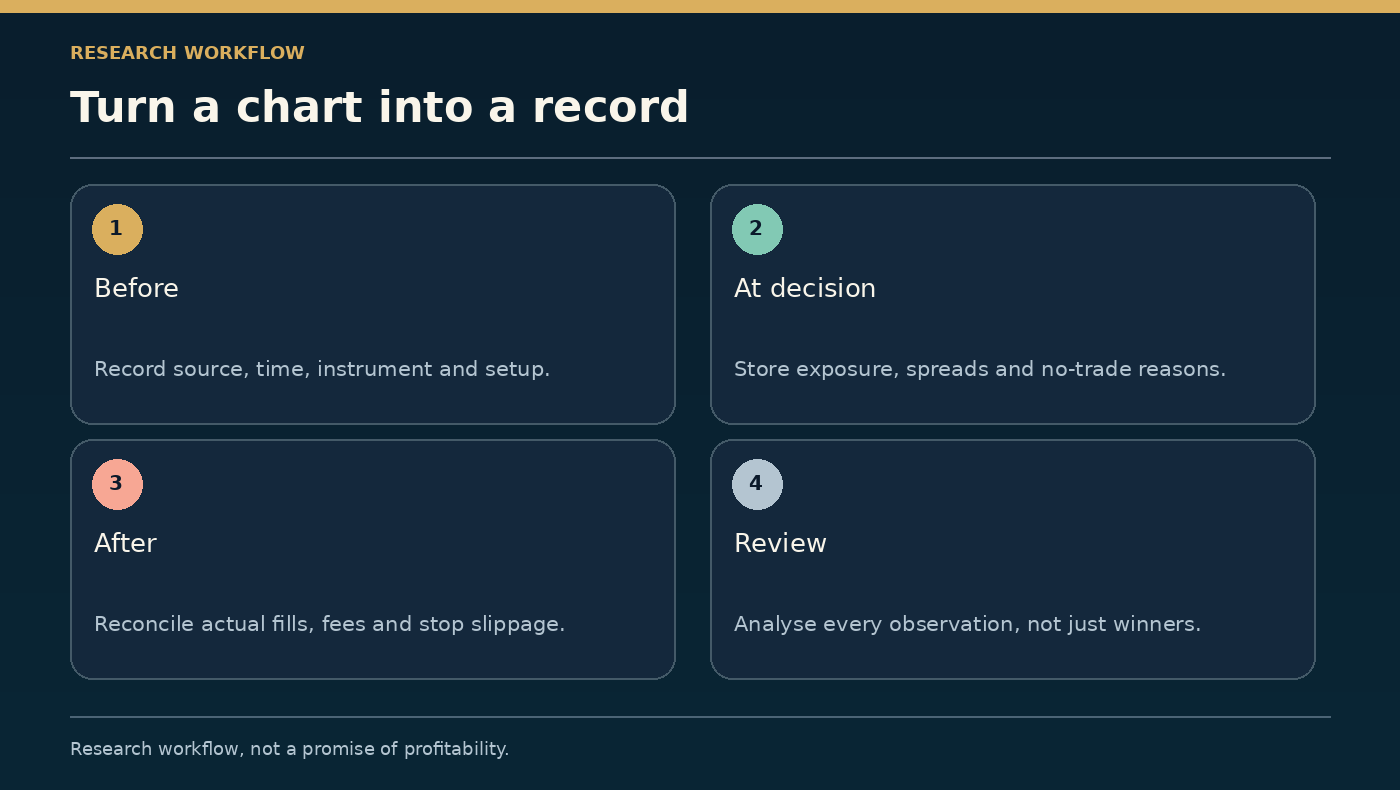
Lesson 6: Maintain a decision journal, not only a win list
Record the market, instrument, quote side, timestamp, planned decision, cancellation conditions, size in ounces and actual confirmed order status. Afterward, reconcile fills, financing and commissions against the broker’s account statement. Include no-trade decisions and mistakes. A handful of wins is not evidence of a statistically reliable strategy.
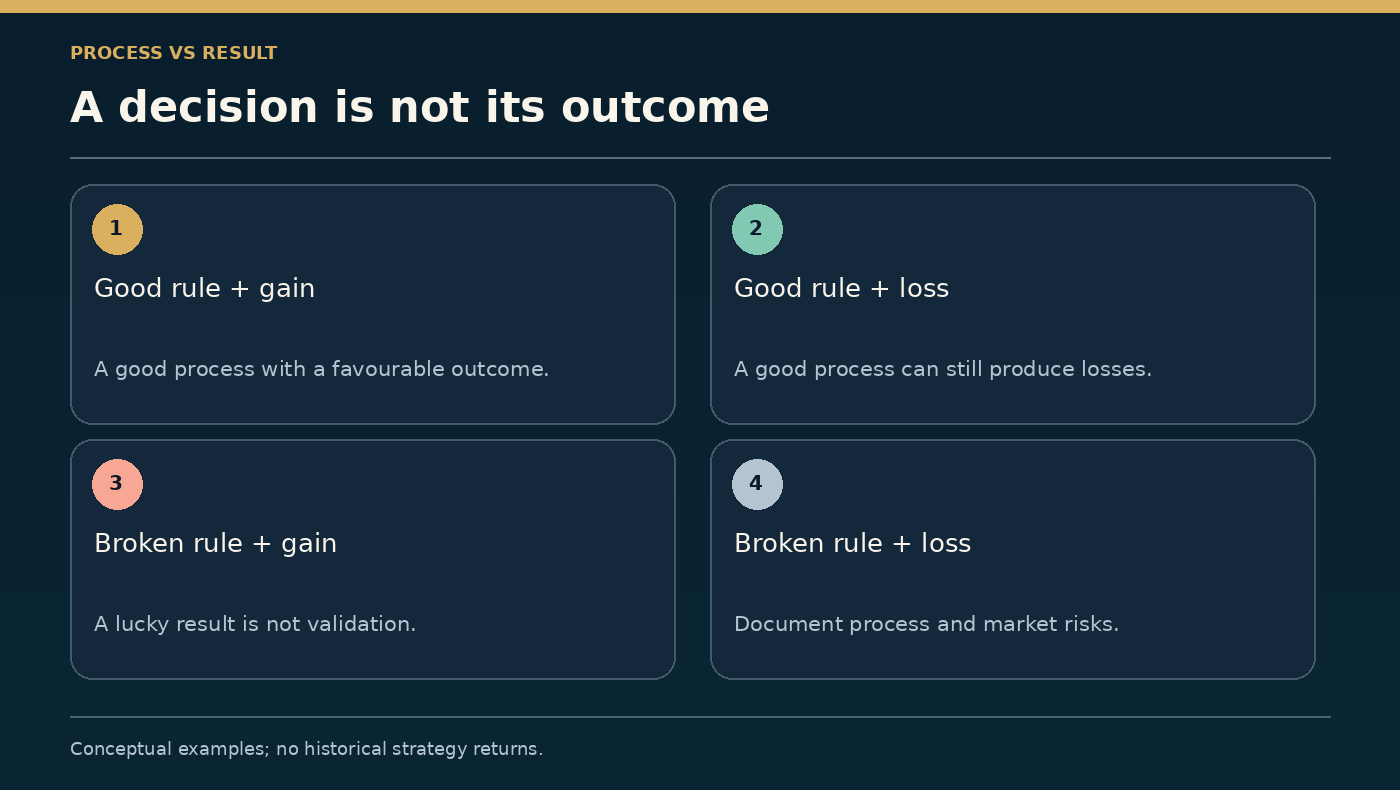
Worked example: process versus outcome
| Process | Favourable outcome | Adverse outcome |
|---|---|---|
| Followed predefined rules | Correct process, not proof of an edge | Correct process can still lose |
| Improvised or breached rules | Lucky outcome, still review error | Review error and financial effect |
This is a framework for evaluating decisions, not a quantified return model. Realistic risk learning separates what could be controlled at the time from the price path that followed.
Verify a service provider before sending funds
An attractive website or platform logo does not establish that a firm holds the relevant authorisation. For Singapore consumers, check the exact entity and permitted activity in the MAS Financial Institutions Directory, follow official contact details and be sceptical of guaranteed monthly returns or pressure to deposit quickly. Avoid assuming a named trading platform is regulated merely because charting tools integrate with it.
A reusable five-minute preparation routine
- Read the instrument’s legal and contract specifications.
- Identify a dated market observation and upcoming releases.
- Define the trigger, cancellation and reason to stay out.
- Calculate total ounce exposure and adverse fill risk.
- Record the decision and compare it with actual execution after the session.
Frequently asked questions
- Will discipline guarantee positive returns? No; a process can be consistent yet unprofitable.
- Is gold always a safe haven? No; its response depends on the surrounding market.
- Can a demo prove a strategy? No; simulated fills and costs may differ from live trading.
- Is a no-trade day a failure? Not when it follows a reasonable predetermined filter.
Key takeaway
Develop observable habits and product literacy before searching for the ‘right’ gold signal. Better questions improve transparency and decision quality, but cannot eliminate market risk.
Continue learning
Sources
- Singapore MoneySense — Understanding CFDs
- MAS Financial Institutions Directory
- CFA Institute — Backtesting and Simulation
Educational information only. All dollar figures and strategy scenarios are hypothetical. Gold, derivatives and leveraged products involve material loss risk. This article does not offer personal financial advice.