

Many forex platforms display XAU/USD beside currency pairs, but gold is a commodity, not simply another currency pair. The instrument shown may be an over-the-counter contract for difference (CFD), under which a customer takes exposure to a provider’s gold quotation rather than buying bullion. This illustrated guide explains the difference, the calculations worth checking, and a practical way to learn without treating gold trading as an assured source of income.
1. Understand what XAU/USD means
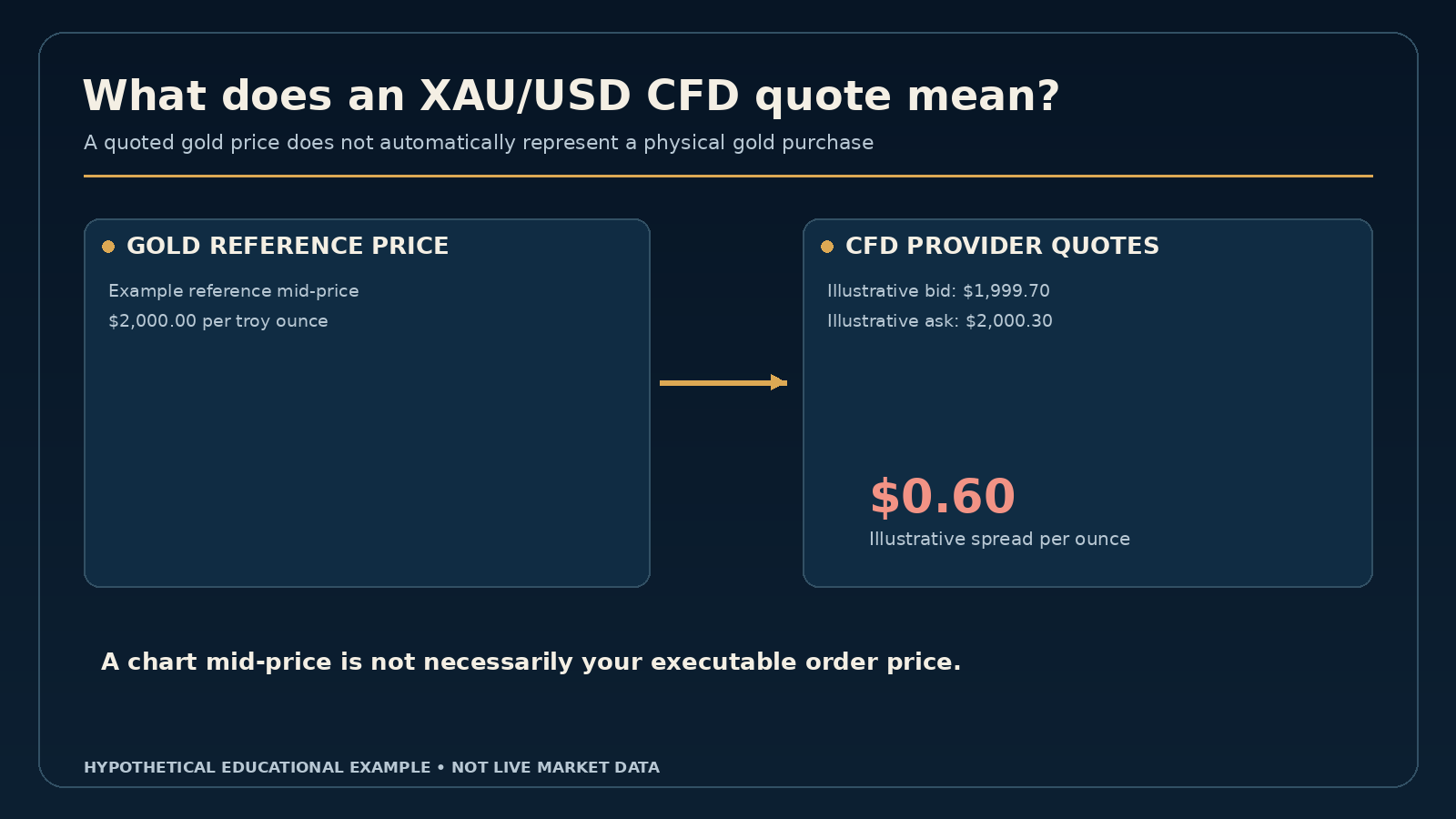
XAU is the code commonly used for one troy ounce of gold and USD indicates a US-dollar quotation. A displayed value of $2,000 per ounce is a hypothetical reference price in this article, not a current market price. On a CFD account, the broker may quote separate bid and ask prices around a reference mid-price, and these executable quotes can differ across providers.
Suppose a provider shows bid $1,999.70 and ask $2,000.30 around a $2,000 mid-price. The difference is $0.60 per ounce. A trader opening a long position at the ask and immediately closing at the bid would incur an approximate spread cost of $0.60 per ounce even if the reference price remained unchanged. A 10-ounce exposure would incur a $6 difference, before any additional commissions.
2. Identify which gold product you actually trade
| Instrument | What the account holds | Practical distinction |
|---|---|---|
| Physical gold | Bars or coins owned under the purchase terms | Storage and dealer resale costs |
| Gold ETF/fund | Fund units or shares | Fund structure and fees |
| Exchange gold futures | An exchange-traded standardised derivative contract | Contract size, expiry, exchange margin |
| Retail XAU/USD CFD | A contract against the CFD provider | Leverage, broker quotes, finance and counterparty risk |
Standard CME Gold futures (GC) represent 100 troy ounces per contract. CME also lists a separate 1-Ounce Gold futures product that has a distinct settlement method and 24/7 schedule subject to maintenance. Neither is necessarily what a retail forex platform means by ‘1.00 lot’ or ‘0.01 lot’. Read CME contract specifications and the 1OZ futures FAQ for current product details.
3. Read broker lot specifications before doing any calculation
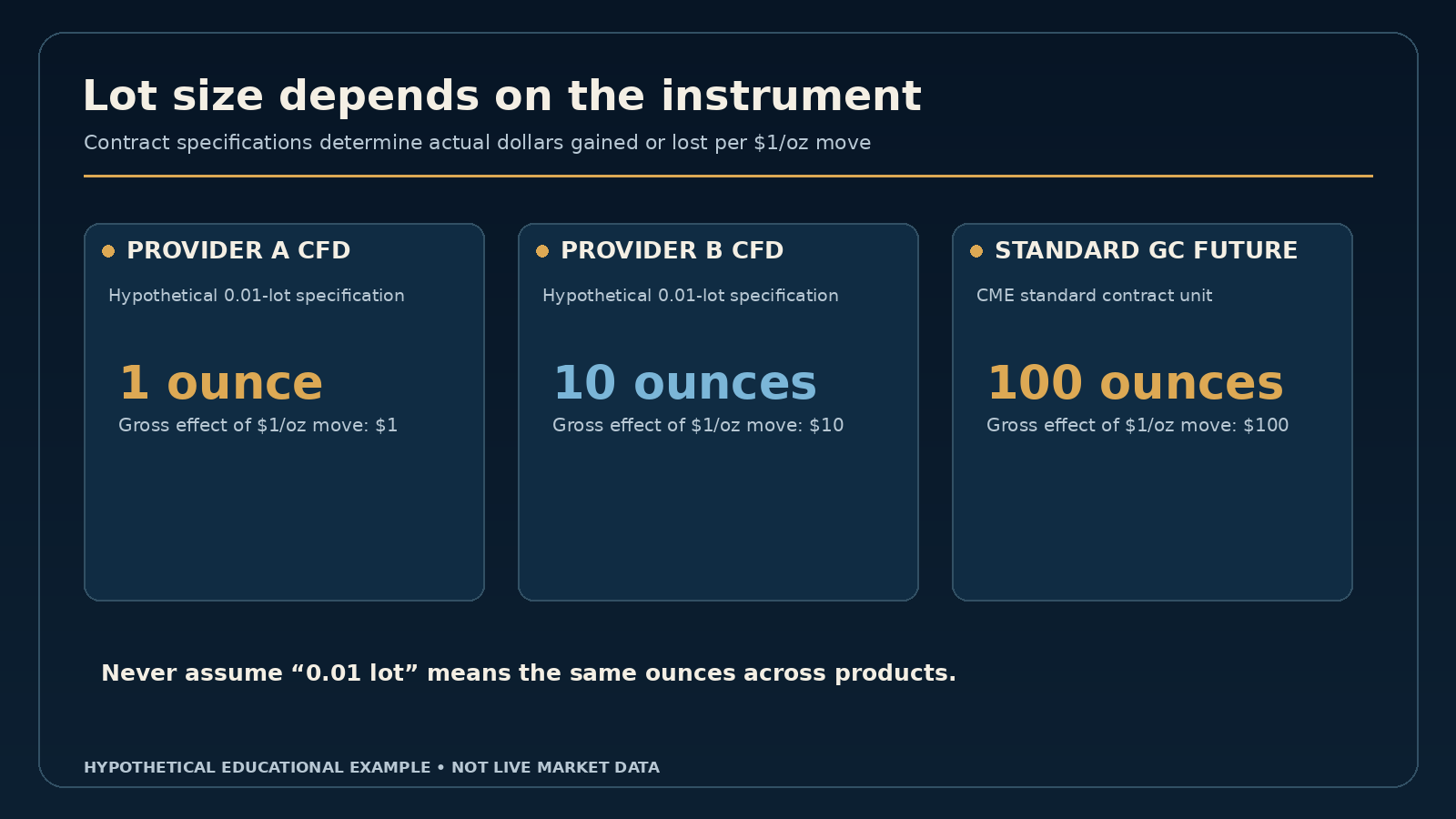
The original article treated 1.00 CFD lot as 100 ounces and therefore 0.01 lot as one ounce. That may hold for a particular provider but is not a universal contractual standard. To work out exposure, find the broker’s exact instrument specification: ounces per full lot, minimum size, quote increment, currency, dealing hours and whether a position can be partially closed.
For example, if a hypothetical provider defines one lot as 100 ounces, a 0.01-lot trade equals one ounce. If another provider defined one lot as 1,000 ounces, 0.01 would represent ten ounces. A $1-per-ounce gold move would then correspond to $1 of gross price change on the first position and $10 on the second. Identical lot numbers would hide a tenfold exposure difference.
4. Check notional value, margin and dollar exposure
Notional exposure for a simple ounce-based product equals the number of ounces multiplied by the relevant dollar price per ounce. If a hypothetical 5-ounce CFD is quoted at $2,000/oz, its notional exposure is $10,000. If the provider requested 10% initial margin, that would require $1,000 collateral. But a $20/oz adverse movement could still cause a $100 gross loss, regardless of how much margin was initially posted.
| Hypothetical field | Value |
|---|---|
| Gold reference price | $2,000 per troy ounce |
| Exposure | 5 ounces |
| Notional exposure | 5 × $2,000 = $10,000 |
| Initial margin at 10% | $1,000 |
| Gross price effect of −$20/oz | 5 × −$20 = −$100 |
Margin is not a loss ceiling. Singapore MoneySense’s CFD investor guide warns that losses may exceed the deposit, and a broker stop may not execute at the specified trigger price. Singapore readers should also check applicable investor knowledge assessments and the precise legal entity offering the product.
5. Learn the costs hidden behind a chart
- Spread: the difference between the currently executable buy and sell quotes, which may widen around volatility.
- Commission: an additional charge that some providers levy at entry or exit.
- Financing: a charge or adjustment that may apply when a CFD is held overnight.
- Conversion: the effect of account currency differing from the currency in which the contract settles.
- Slippage: a completed order price that differs from the anticipated trigger or displayed quote.
6. How to observe gold prices without treating charts as forecasts
CPI, central-bank decisions, real yields, the dollar and changes in risk appetite can each influence gold. These channels vary across market regimes: gold and the dollar can sometimes rise together, and a rising inflation figure does not guarantee gold will gain. An hourly moving average, RSI or a candle formation summarises previous observations; it does not identify a certain next price.
Choose a data source and timeframe, record timestamps and compare it with the provider’s actual bid and ask. A chart from another institution can use different session boundaries, price sources or futures rolls. Avoid assuming a line labelled ‘support’ contains verified unfilled bank orders.
7. An honest strategy-testing framework
- Define a completed-bar entry hypothesis without looking at later candles.
- Record an invalidation condition, including circumstances in which no trade is appropriate.
- Determine ounce exposure from a planned dollar budget and a stop-trigger distance, subject to the provider’s minimum unit.
- Include costs, adverse fills and rare gaps rather than assuming the stop always caps loss.
- Measure every qualifying setup on a fixed sample and compare with a later unseen sample.
- Practise broker order-entry operations in a demo account, recognising simulated fills can be more favourable than live fills.
A target three times a $20 planned loss distance creates an illustrative 1:3 payoff-distance ratio. At exactly 3 units won per winner and 1 unit lost per loser, gross break-even occurs at a 25% win rate (not 33%), ignoring costs. Costs and occasional larger losses would raise the required hit rate. A ratio alone does not create a trading edge.
8. The learning sequence before a live trade
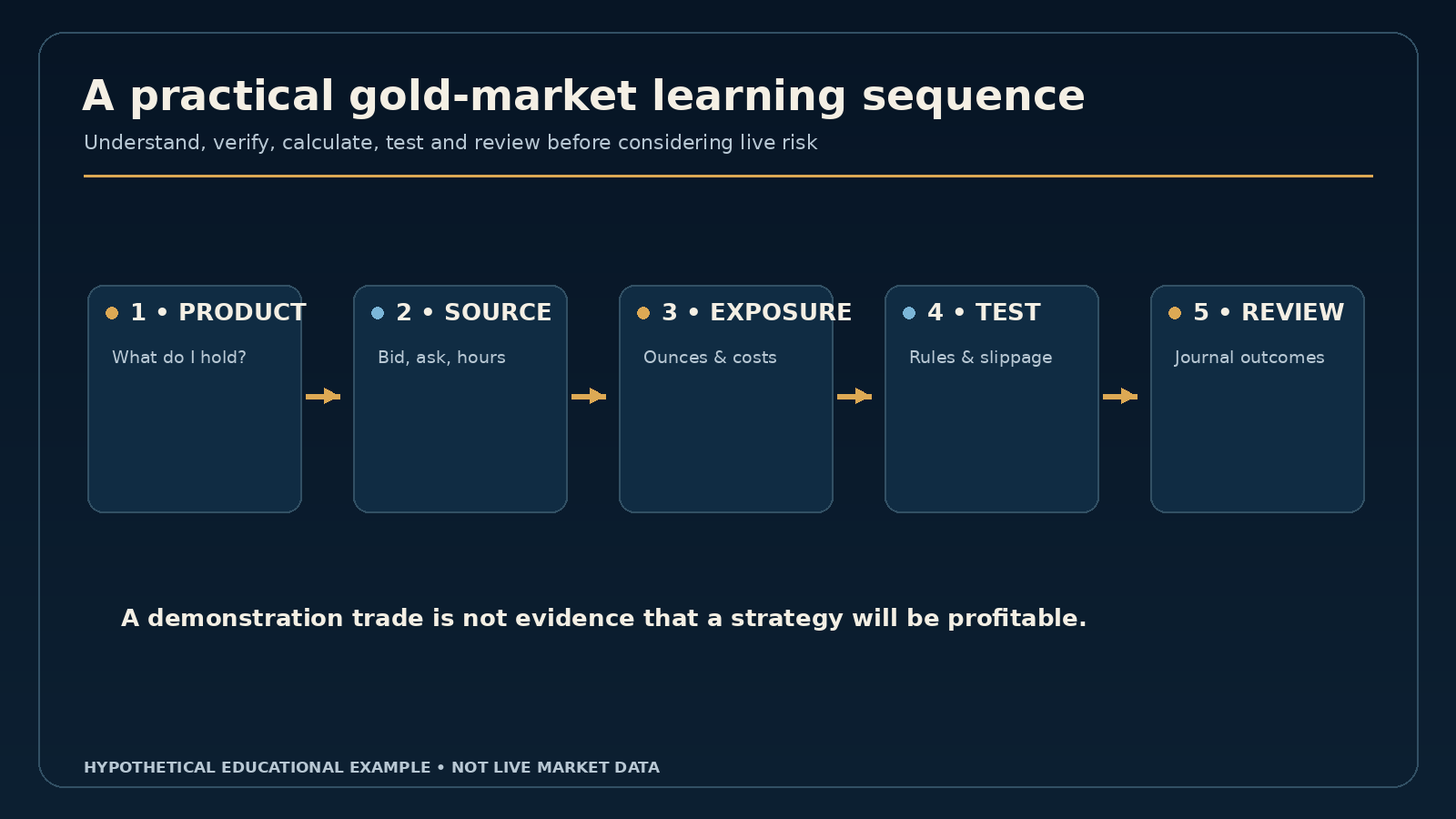
Start by identifying the exact product, verify market hours and authoritative data sources, calculate dollar-per-ounce exposure, test one clearly defined rule, then record decisions and actual fills. If the available minimum lot size exceeds the planned budget—or product terms remain unclear—remaining flat is the reasonable outcome. The aim is financial literacy, not a prompt to open an account.
Frequently asked questions
- Is gold a currency pair? XAU/USD is a gold quotation. A CFD based on gold is a derivative, not simply exchanging and owning two currencies.
- Does a 0.01 lot always equal one ounce? No. Check the provider’s legal contract specifications.
- Can a beginner lose more than the deposit? Yes, depending on the contract and local protections; review provider documentation.
- Do profitable demo trades prove a strategy works? No. Real spreads, fills and market conditions may differ.
Key takeaway
Learning to trade gold through a forex platform starts with understanding the product and its execution conditions. Calculate actual ounces and costs before considering any prediction about where gold might move.
Continue learning
Sources
Educational material only. All figures are hypothetical and do not represent current XAU/USD prices, available margin quotations or an investment recommendation. Leveraged gold products can cause significant losses.